Difference between Dictatorship and Democracy
Dr. Tanmoy Mukherji
Advocate
Difference between Dictatorship and Democracy-
Tanmoy Mukherji
Advocate
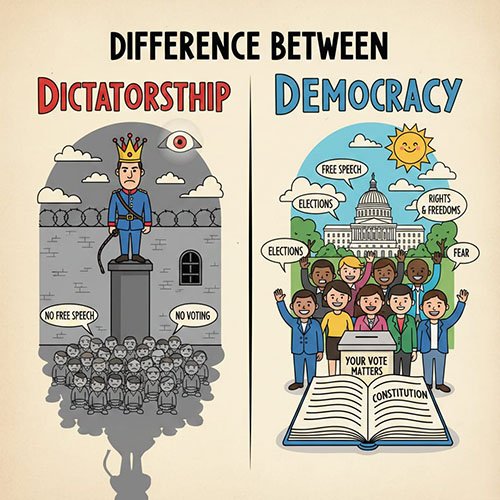
Concept and Definition-
→Dictatorship is a system of government in which political power is monopolized by one individual or a small elite group. The ruler governs without constitutional limitations and does not derive authority from the consent of the governed. The term originates from the Roman concept of an extraordinary magistrate appointed during emergencies, but in modern usage it signifies authoritarian rule.
→Democracy is a form of government in which sovereignty lies with the people. Abraham Lincoln defined democracy as “government of the people, by the people, and for the people.” Authority is exercised either directly or indirectly through elected representatives under a constitutional framework.
Source and Legitimacy of Power-
→In a dictatorship, legitimacy is usually claimed through force, military takeover, revolution, heredity, or ideological supremacy. Consent of the people is not essential, and power is often maintained through coercion.
→In a democracy, legitimacy flows from the will of the people expressed through periodic, free, and fair elections. The government’s authority is morally and legally justified by popular consent.
Nature of Authority-
→Dictatorial authority is absolute or highly centralized. The ruler’s will is supreme, and checks on power are either absent or merely symbolic.
→Democratic authority is limited and decentralized. Power is distributed among different organs of government and exercised within constitutional boundaries.
Constitutional Framework-
→In a dictatorship, the constitution may be suspended, amended arbitrarily, or ignored. Emergency powers are often used to justify unlimited authority.
→In a democracy, the constitution is supreme. It defines the structure of government, limits state power, and protects citizens’ rights.
Rule of Law vs Rule of Man-
→A dictatorship is governed by the rule of man, where personal commands override legal norms. Law becomes an instrument of control rather than justice.
→A democracy operates on the rule of law, ensuring equality before law and guaranteeing that governmental actions are legally justified and judicially reviewable.
Fundamental Rights and Civil Liberties-
→Under dictatorship, fundamental rights such as freedom of speech, expression, press, religion, and association are restricted or denied. Surveillance, censorship, and repression are common.
→Under democracy, fundamental rights are recognized as inherent and are constitutionally protected. Independent courts enforce these rights against state interference.
Political Participation-
→In a dictatorship, political participation is minimal or forced. Elections, if held, are often sham exercises with predetermined outcomes.
→In a democracy, political participation is voluntary and meaningful. Citizens engage through voting, political parties, civil society, and public debate.
Party System-
→A dictatorship usually allows only one political party or none at all. Opposition parties are banned or suppressed.
→A democracy is characterized by a multi-party system where political competition is encouraged and opposition is legally recognized.
Opposition and Dissent-
→In dictatorship, dissent is considered a threat to the regime and is often met with imprisonment, exile, or violence.
→In democracy, dissent is viewed as essential for healthy governance. Peaceful criticism and protest are lawful and protected.
Accountability and Responsibility-
→A dictator is not accountable to the people or legislature and often rules for life.
→In a democracy, the government is accountable to the legislature, judiciary, media, and ultimately the electorate. Failure in governance can lead to removal through elections or impeachment.
Role of Judiciary
→In dictatorship, the judiciary is subordinate to the executive and lacks independence.
→In democracy, the judiciary is independent and acts as the guardian of the constitution and fundamental rights.
Media and Freedom of Press-
→A dictatorship controls or censors the media to shape public opinion and suppress criticism.
→A democracy ensures freedom of press, allowing media to function as the “fourth pillar” of democracy.
Decision-Making Process-
→Dictatorship allows quick decision-making due to centralized power, but decisions often ignore public welfare and accountability.
→Democracy involves deliberation and debate, which may be slow but results in more inclusive and balanced policies.
Stability and Change-
→A dictatorship may appear stable but is often fragile and prone to violent overthrow.
→A democracy provides institutional mechanisms for peaceful change of government, ensuring long-term stability.
Impact on Society-
→Dictatorship promotes fear, conformity, and political apathy among citizens.
→Democracy encourages political awareness, civic responsibility, and social development.
International Outlook-
→Dictatorships often face international criticism for human rights violations.
→Democracies generally enjoy greater legitimacy and cooperation in the international community.
Examples-
Dictatorship: Nazi Germany (Hitler), Fascist Italy (Mussolini), Military regimes.
Democracy: India, United States, United Kingdom.
-Dictatorship is characterized by concentration of power, suppression of freedoms, and absence of accountability, whereas democracy is based on popular sovereignty, constitutionalism, protection of rights, and rule of law. While dictatorship may ensure efficiency, democracy ensures justice, liberty, and human dignity.

we believe in a holistic approach to legal education building not just lawyers, but socially conscious leaders of tomorrow.
