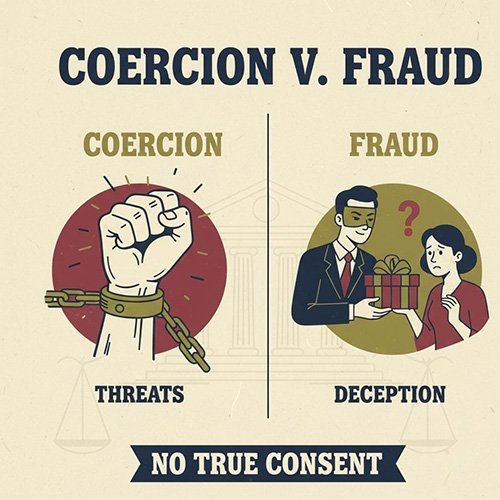
Difference between Coercion and Fraud
Indian Contract Act, 1872
TANMOY MUKHERJI INSTITUTE OF JURIDICAL SCIENCE
Dr. Tanmoy Mukherji
[Advocate]
Difference between Coercion and Fraud-
Tanmoy Mukherji
[Advocate]
|
Basis
|
Coercion
|
Fraud
|
|
1.Section
|
Section 15 of The Indian Contract Act, 1872
|
Section 17 of The Indian Contract Act, 1872
|
|
2. Definition
|
"Coercion" is the committing, or threatening to commit, any act forbidden by the Bharatiya Nyaya Sanhita or the unlawful detaining, or threatening to detain, any property, to the prejudice of any person whatever, with the intention of causing any person to enter into an agreement.
|
"Fraud" means and includes any of the following acts committed by a party to a contract, or with his connivance, or by his agent, with intent to deceive another party thereto or his agent, or to induce him to enter into the contract: (i) the suggestion as a fact, of that which is not true, by one who does not believe it to be true; (ii) the active concealment of a fact by one having knowledge or belief of the fact; (iii) a promise made without any intention of performing it; (iv) any other act fitted or deceive; (v) any such act or omission as the law specially declares to be fraudulent.
|
|
3.Nature of act
|
Use or threat of physical force or illegal omission.
|
Use of deception, misrepresentation or false statement.
|
|
4) Means used
|
Physical or unlawful pressure (e.g., threats, unlawful detention).
|
Deceptive acts or false representation (e.g., lying about facts).
|
|
5) Intention
|
To compel the other party to give consent.
|
To deceive or mislead the other party to obtain consent.
|
|
6) Consent
|
Not free because it is obtained by threat or force.
|
Not free because it is obtained by deception.
|
|
7) Effect on contract
|
Voidable contract at the option of the party whose consent was obtained by Coercion.
|
Voidable contract at the option of the party deceived by fraud.
|
|
8) Criminal offence
|
The act used for coercion is a criminal offence.
|
The act of fraud may also be a criminal offence but depends on the nature of deceit.
|
|
9) Example
|
Mr. A threatens to harm Mr. B's brother unless Mr. B signs an agreement - this is coercion.
|
Mr. A sells a fake painting claiming it is an original - this is fraud.
|
|
10) Reference Case
|
|
|

we believe in a holistic approach to legal education building not just lawyers, but socially conscious leaders of tomorrow.