DETERMINATION OR TERMINATION OF LEASE
Transfer of Property Act, 1882
Dr. Tanmoy Mukherji
Advocate
DETERMINATION OR TERMINATION OF LEASE [Section 111 of the Transfer of Property Act, 1882]-
Tanmoy Mukherji
Advocate
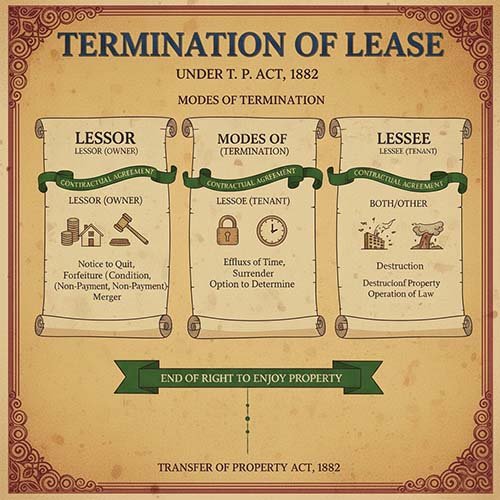
Section 111 of the T.P. Act provides for the termination of lease under different circumstances. It runs as follows:
A lease of immovable property determines-
(a) By efflux of the time limited thereby;
(b) Where such time is limited conditionally on the happening of some event - by the happening of such event;
(c) Where the interest of the lessor in the property terminates on, or his power to dispose of the same extends only to the happening of any event- by the happening of such event;
(d) In case the interests of the lessee and the lessor in the whole of the property become vested at the same time in one person in the same right;
(e) By express surrender; that is-to-say, in case the lessee yields up his interest under the lease to the lessor, by mutual agreement between them;
(f) By implied surrender;
(g) By forfeiture; that is to say-
1. In case the lessee breaks an express condition which provides that, on breach thereof, the lessor may re-enter; or
2. In case the lessee renounces his character as such by setting up a title in a third person or by claiming-title in himself; or
3. The lessee is adjudicated an insolvent and the lease provides that the lessor may re-enter on the happening of such event;
-and in any of these cases the lessor or his transferee gives notice in writing to the lessee of his intention to determine the lease.
(h) On the expiration of a notice to determine the lease, or to quit, or of intention to quit, the property leased, duly given by one party to the other.
Illustration to Clause (f)-
A lessee accepts from his lessor a new lease of the property leased, to take effect during the continuance of the existing lease. This is an implied surrender of the former lease, and such lease determines thereupon.
This section is not applicable to agricultural leases as contained in Section 117 of the Act.
Following are the circumstances under which a lease can be terminated-
1. By Efflux of the time (Expiry of Time) [Section 111(a)].
2. By happening of an event [Section 111(b)].
3. By termination of Lessor's Interest [Section 111(c)].
4. By Merger [Section 111(d)].
5. By express surrender [Section 111(e)].
6. By implied surrender [Section 111(f)]; and
7. By forfeiture [Section 111(g)].
1. By Efflux of the Time (Expiry of Time) [Section 11 1(a)]-
A lease may be created for a specific period. On expiry of the period, the lease is terminated without any formality. No notice need be served from either side.
2. By happening of an event [Section 111(b)]-
If the term of lease is subject to the condition of happening of an event, the lease is terminated upon the happening of such event (It is to be noted that leasehold interest is transferable and heritable).
3. By Termination of Lessor's Interest [Section 111(c)]-
Lease is effective so long as the lessor is having interest/right/authority over the property. When his authority/ interest over it is terminated, the lease also stands terminated automatically.
4. By merger [Section 111(d)]-
Merger means uniting together, Where the rights/ interests of both lessor and lessee are vested in the same person, it amounts to merger. Merger terminates lease since the same person cannot be both lessor and lessee.
5. By express surrender [Section 111(e)]-
Lessee, with the consent of lessor may surrender or yield-up-his interest in lease to the lessor. Such surrender to Lessor by Lessee terminates the lease.
6. By implied surrender [Section 111(f)]-
Surrender of leasehold property may be inferred from the act of parties. When a lessee accepts from his lessor a new lease of the leased property during the continuance of existing lease, it is an implied surrender of the former lease, which amounts to termination.
7.By forfeiture [Section 111(g)]-
Lease stands terminated by forfeiture in the following cases-
(i) Breach of condition- Lessor can re-enter the property if the Lessee commits breach of condition.
(ii) Denial of landlord (Lessor's) title- If the lessee denies the title of lessor, sets up the same in himself or in third person, such conduct is sufficient to forfeit the lease.
(iii) Insolvency of the lessee- It is a good ground for forfeiture of lease.

we believe in a holistic approach to legal education building not just lawyers, but socially conscious leaders of tomorrow.
