DETAILED DIFFERENCE BETWEEN STRIDHAN AND WOMAN’S ESTATE, UNDER HINDU LAW AND HINDU SUCCESSION ACT, 1956-
Dr. Tanmoy Mukherji
Advocate
DETAILED DIFFERENCE BETWEEN STRIDHAN AND WOMAN’S ESTATE, UNDER HINDU LAW AND HINDU SUCCESSION ACT, 1956-
Tanmoy Mukherji
Advocate
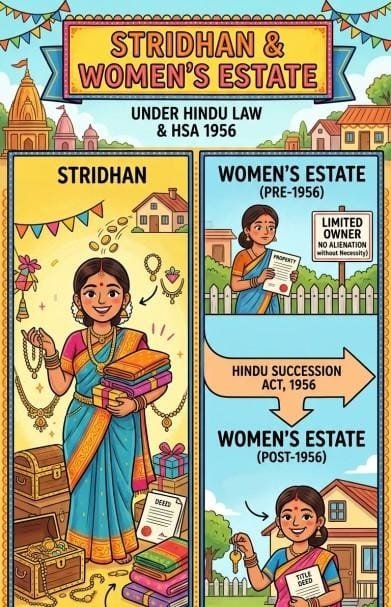
Stridhan means property over which a Hindu woman traditionally has absolute ownership.
Woman's Estate (limited estate) under old Hindu law gave a woman only limited proprietary interest with restricted powers of alienation.
Section 14 of the Hindu Succession Act, 1956, converts qualifying limited estates into absolute ownership.
CONCEPT AT A GLANCE-
|
STRIDHAN
|
WOMAN'S ESTATE (OLD HINDU LAW)
|
|
Absolute Ownership |
Limited Ownership
|
|
Full power of enjoyment, alienation, gift, sale, mortgage etc. Property remains her own property.
|
Enjoyment with restricted powers of alienation. On termination, goes to reversioners.
|
DETAILED DIFFERENCE CHART-
|
BASIS |
STRIDHAN
|
WOMAN'S ESTATE (OLD HINDU LAW)
|
|
Meaning |
Property belonging absolutely to a woman. |
Property in which a woman had limited proprietary interest.
|
|
Nature of ownership |
Absolute ownership. |
Limited ownership. |
|
Power of disposal |
Generally full power of disposal. |
Traditionally restricted.
|
|
Sale / Gift / Mortgage |
Ordinarily permissible. |
Allowed only in certain circumstances (e.g., legal necessity).
|
|
Inheritance |
Devolves according to Hindu succession law. |
On termination, property goes to reversioners.
|
|
Source |
May be gifts, earnings, purchase, acquisition, etc. |
Often inheritance or property given to a woman (old law).
|
|
Rights during lifetime |
Full proprietary rights. |
Enjoyment with restricted proprietary powers.
|
|
After HSA, 1956 |
Continues as absolute property. |
By Sec. 14(1) enlarged into absolute ownership (subject to Sec. 14(2)).
|
|
Present importance |
Still legally relevant. |
Mainly historical, except for Sec. 14 issues.
|
WHAT IS STRIDHAN?
The term 'Stridhan' literally means 'woman's property'.
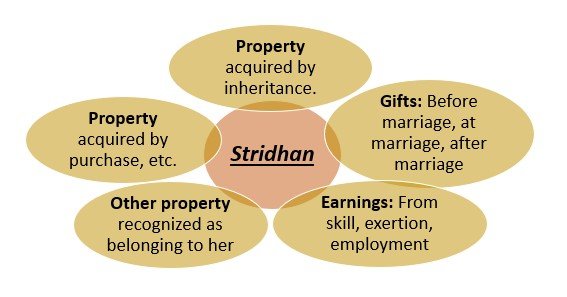
All these are the woman's absolute property. She has full power of enjoyment and disposal.
WOMAN'S ESTATE UNDER OLD HINDU LAW-
A limited estate was different from Stridhan.
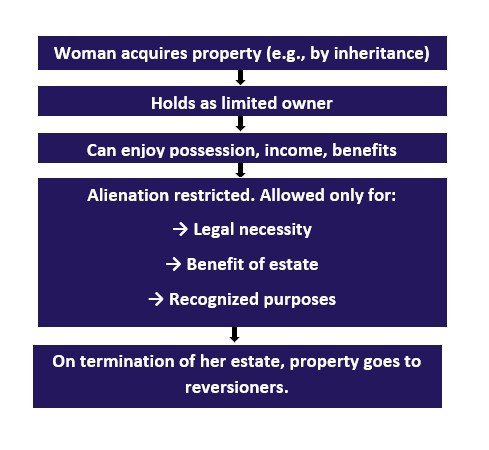
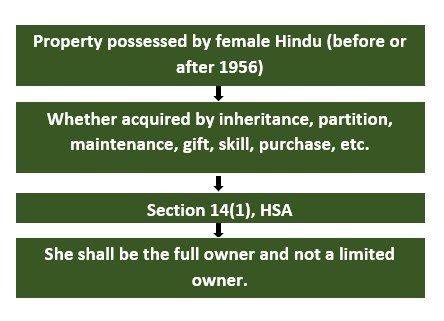
SECTION 14, HINDU SUCCESSION ACT, 1956 — ENLARGING EFFECT-
Section 14(1) converts the limited estate of a Hindu woman into absolute ownership in qualifying cases.
Exception: Section 14(2)-
If property is acquired for the first time by gift, will, instrument, decree, order or award and the terms themselves create a restricted estate, the restriction may continue.
COMPARISON DIAGRAM-
|
STRIDHAN
|
WOMAN'S ESTATE (OLD HINDU LAW)
|
|
→Woman's own property →Absolute ownership →Full power of alienation →No reversioners →Devolves as her property →Still relevant today
|
→Property with limited estate →Limited ownership →Alienation restricted →Reversioners exist →On termination, goes to reversioners →Now enlarged by Sec. 14(1) (subject to Sec. 14(2)).
|
TESTS APPLIED BY COURTS-
|
STRIDHAN
|
WOMAN'S ESTATE (OLD HINDU LAW)
|
|
→Was the property given/received for the benefit of the woman? →Was it intended to be her exclusive property? →Does she have dominion over the property? →Is it separate from the husband's property? →Conduct and surrounding circumstances.
|
→How was the property acquired? →Are there restrictions on alienation? →Is the estate terminable? →Are there reversioners? →Does Section 14(1) or 14(2) apply?
|
IMPORTANT CASE LAWS-
|
Case |
Citation |
Principle |
|
Pratibha Rani v. Suraj Kumar
|
Citation: (1985) 2 SCC 370
|
Stridhan is the woman's absolute property; husband has no right over it.
|
|
V. Tulasamma v. Sesha Reddy
|
(1977) 3 SCC 99
|
Sec. 14(1) has a wide amplitude. Property given in recognition of pre-existing right (e.g., maintenance) becomes absolute (not Sec. 14(2)).
|
|
S.S. Munna Lal v. S.S. Rajkumar
|
AIR 1962 SC 1493
|
Section 14 converts a limited interest into absolute estate.
|
|
Eramma v. Veerupana
|
AIR 1966 SC 1879
|
Sec. 14 does not create title where the woman had no vestige of lawful right.
|
|
Badri Prashad v. Kanso Devi
|
(1969) 2 SCC 586
|
Limited estate of Hindu woman becomes absolute under Sec. 14(1) (qualifying cases).
|
|
Mangal Singh v. Rattno
|
AIR 1967 SC 1786
|
"Possessed by" in Sec. 14 not limited to physical possession only.
|
|
Bai Vajia v. Thakorbhai Chelabhai
|
(1979) 3 SCC 300 |
Sec. 14 applies where possession is founded on legally recognizable right.
|
|
Sadhu Singh v. Gurdwara Sahib Narike
|
(2006) 8 SCC 75
|
Sec. 14(2) applies where restricted estate is created for the first time by will or instrument. |
Flow Chart-
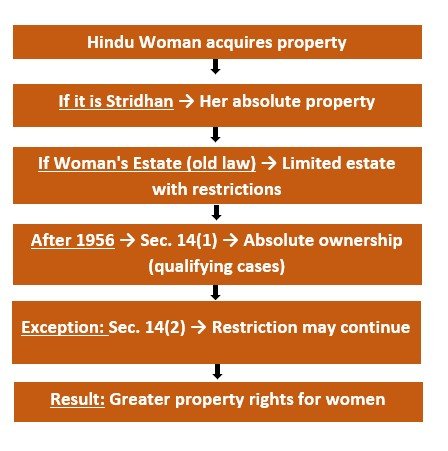
Stridhan is the woman's own absolute property. Woman's Estate was her limited estate under old law.
Section 14, HSA, 1956 enlarged that limited estate into full ownership, except in cases covered by Section 14(2).

we believe in a holistic approach to legal education building not just lawyers, but socially conscious leaders of tomorrow.
