Detailed comparison between Inquiry, Investigation and Trial, under Bharatiya Nagarik Suraksha Sanhita, 2023
Dr. Tanmoy Mukherji
Advocate
Detailed comparison between Inquiry, Investigation and Trial, under Bharatiya Nagarik Suraksha Sanhita, 2023-
Tanmoy Mukherji
Advocate
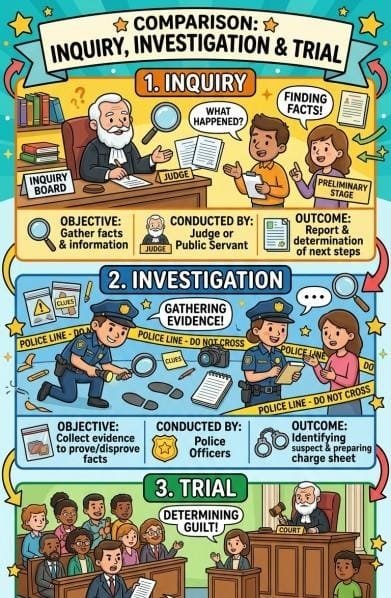
|
Basis
|
Investigation
|
Inquiry
|
Trial
|
|
Meaning
|
Process of collecting evidence regarding an alleged offence.
|
Judicial proceeding conducted by a Magistrate/Court other than a trial.
|
Judicial adjudication of the accusation against the accused.
|
|
Authority
|
Police officer or other person authorised by law.
|
Magistrate or Court.
|
Competent criminal Court.
|
|
Nature
|
Primarily executive / investigative.
|
Judicial
|
Judicial and adjudicatory.
|
|
Main object
|
Discover facts, identify offender and collect evidence.
|
To examine the matter for the purpose prescribed by law.
|
To determine guilt or innocence.
|
|
Stage
|
Generally, the earliest of the three.
|
After the matter enters judicial proceedings, wherever provided.
|
After the case proceeds for trial.
|
|
Evidence
|
Evidence/material is collected. |
Material/evidence is judicially considered according to the inquiry.
|
Evidence is formally proved, tested and appreciated.
|
|
Witnesses
|
Police may examine persons acquainted with facts.
|
Court may examine persons (where applicable).
|
Witnesses give evidence and may be cross-examined.
|
|
Search & seizure
|
Important investigative functions subject to law.
|
Not its defining purpose.
|
Court considers admissible evidence resulting from such processes.
|
|
Arrest
|
Police may arrest where statutory requirements are satisfied.
|
Court exercises relevant judicial powers.
|
Accused faces adjudication before court.
|
|
Cross-examination
|
No trial-style cross-examination.
|
Depends on the nature of the inquiry.
|
Yes, according to law.
|
|
Standard
|
Investigating officer assesses collected material.
|
Statutory standard applicable to the particular inquiry.
|
Proof beyond reasonable doubt for conviction.
|
|
Determines guilt?
|
No
|
No
|
Yes |
|
Typical result
|
Police report / charge-sheet / final report.
|
Judicial order
|
Acquittal or conviction.
|
Nature at a Glance-
|
Investigation
|
Inquiry
|
Trial
|
|
→Fact finding →Evidence collection →Executive function
|
→Judicial examination →Not a trial →Purpose as per law
|
→Adjudication →Determination of guilt or innocence →Judicial trial
|
Flow of Criminal Proceedings-
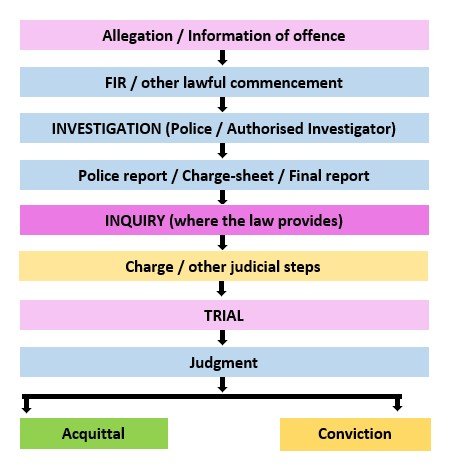
Illustration-
Allegation- A is alleged to have murdered B.
Investigation- Police visit the scene, recover weapon, examine witnesses, collect CCTV, obtain forensic reports and submit report.
Inquiry- Magistrate/Court judicially examines the matter for the statutory purpose. It is not the trial.
Trial- Prosecution evidence is led, witnesses are cross-examined, defence is heard and court decides whether A is guilty beyond reasonable doubt.
Important Judicial References-
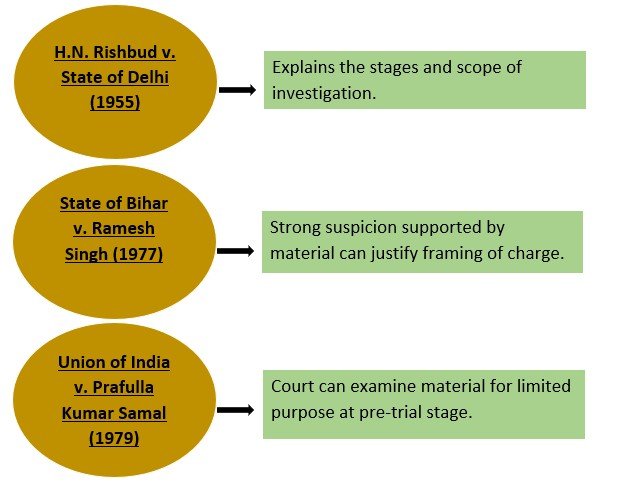
Key Distinction-
|
Investigation
|
Inquiry
|
Trial
|
|
Collection of evidence. |
Judicial examination other than trial. |
Judicial determination of guilt or innocence. |
Significance-
“Police investigate → Court inquires where required → Court tries → Court decides guilt or innocence.”

we believe in a holistic approach to legal education building not just lawyers, but socially conscious leaders of tomorrow.
