Detailed comparison between Inquiry and Investigation, under Bharatiya Nagarik Suraksha Sanhita, 2023 (BNSS)-
Dr. Tanmoy Mukherji
Advocate
Detailed comparison between Inquiry and Investigation, under Bharatiya Nagarik Suraksha Sanhita, 2023 (BNSS)-
Tanmoy Mukherji
Advocate
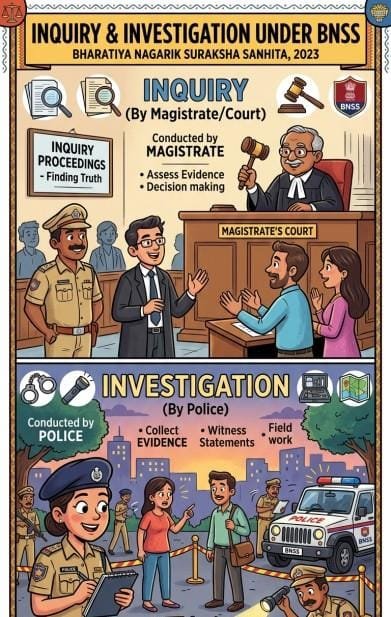
Meaning-
Inquiry: A judicial proceeding other than a trial, conducted by a Magistrate or Court to examine the matter and decide whether there is sufficient basis to proceed.
Investigation: Process of collecting evidence relating to an alleged offence, primarily conducted by a police officer or other person authorised by law, with a view to discover facts, identify the offender and collect evidence.
Authorities Involved-
Inquiry: Magistrate / Court
Investigation: Police Officer / Authorised Investigating Agency
Nature and Purpose-
Inquiry:
→Judicial in nature
→To examine the matter judicially
→To determine whether there is sufficient basis to proceed
→Not a trial
Investigation:
→Primarily executive / investigative
→To discover facts and collect evidence
→To identify the offender
→To prepare police report (charge-sheet / final report)
→Not a trial
Detailed Comparison-
|
Basis
|
Inquiry
|
Investigation
|
|
Authority
|
Magistrate or Court.
|
Police officer or other person authorised by law.
|
|
Nature
|
Judicial
|
Primarily executive
|
|
Main purpose
|
To examine whether there is sufficient basis to proceed.
|
To discover facts, identify offender and collect evidence.
|
|
Typical activities
|
Examination of materials / witnesses, considering further proceedings. |
Visit scene, question persons, search & seizure, arrest (where lawful), collect documents and forensic evidence.
|
|
Stage
|
After the matter reaches court (before trial, where applicable).
|
After information regarding an offence / FIR or other lawful initiation.
|
|
Result
|
Judicial order
|
Police report / charge-sheet / final report
|
|
Control
|
Court / Magistrate
|
Investigating agency (subject to statutory and judicial supervision)
|
|
Is it a trial?
|
No
|
No
|
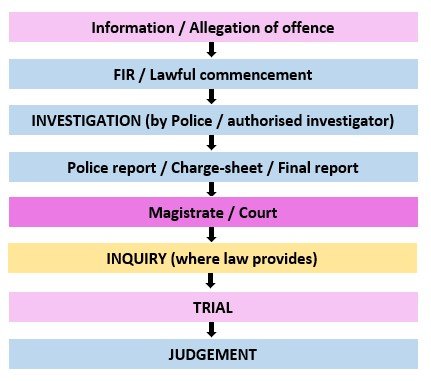
Flow of a Criminal Case-
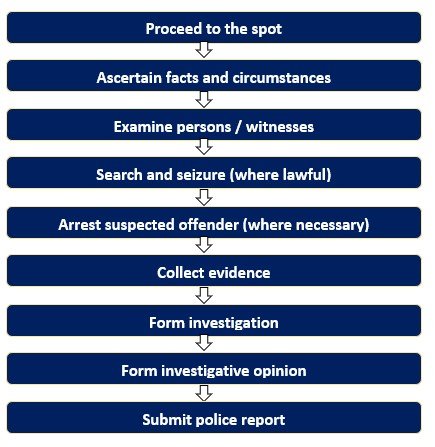
Stages of Investigation-
As explained in H.N. Rishbud v. State of Delhi, 1955-
Important Case Laws-
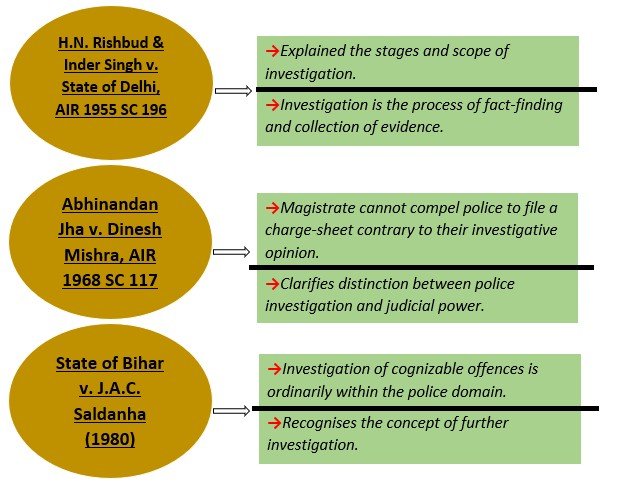
Illustration-
Example: Murder Case-
Police visit the scene, recover weapon, examine neighbours, collect CCTV footage, send samples for forensic examination, arrest suspect and submit police report. These are part of INVESTIGATION.
When the matter comes before the Magistrate, the court examines the material and passes appropriate orders. This is INQUIRY.
Significance -
→Investigation = collection of evidence by police/authorised investigator.
→Inquiry = judicial examination (other than trial) by Magistrate/Court.
→Both are distinct and serve different functions.
→Neither inquiry nor investigation is a trial.
→Investigation does not determine guilt; that is decided at trial.
→Illegality in investigation does not automatically vitiate a trial, prejudice must be shown.

we believe in a holistic approach to legal education building not just lawyers, but socially conscious leaders of tomorrow.
