CONTINGENT INTEREST
The Transfer of Property Act, 1882
Dr. Tanmoy Mukherji
[Advocate]
CONTINGENT INTEREST- The Transfer of Property Act, 1882-
Tanmoy Mukherji
[Advocate]
Where, on transfer of property, an interest is to take effect on the happening of an event, which is certain to occur, it is called vested interest. If the interest is to take effect on the happening of an uncertain event or contingency, it is called contingent interest.
In other words, an interest which arises upon contingency or happening of an uncertain event is called 'Contingent Interest'.
Example-
‘A' transfers his land to 'B' for life and thereafter to 'C', if 'B' had no children. Here, 'C's interest is contingent because it is uncertain whether 'B' would have children or not.
Similarly, 'A' promises 'C' to transfer his property, if, 'B' dies naturally below 30 years. Here 'C's interest is contingent.
Section 21 defines contingent interest as follows-
Where, on a transfer of property, an interest therein is created in favor of a person to take effect only on the happening of a specified uncertain event, or if a specified uncertain event shall not happen, such person thereby acquires a contingent interest in the property. Such interest becomes a vested interest, in the former case, on the happening of the event, in the latter, when the happening of the event becomes impossible.
Exception-
Where, under a transfer of property, a person becomes entitled to an interest therein upon attaining a particular age, and the transferor also gives to him absolutely the income to arise from such interest before he reaches that age, or directs the income or so much thereof may be necessary to be applied for his benefit, such interest is not contingent.
Illustrations:
(1) A grant provided that on the death of the last surviving widow of the late Raja of Tanjore, his daughter or failing her the next heir, if any, should inherit the property. It was held by the Privy Council that until the death of the last surviving widow, the interest created in favor of the daughter was only contingent on her surviving the last widow.
(2) X promised A, B and C, Rs.1,000/- each to be paid to them on the occasion of their marriage. It was held that the gift was contingent upon their marriage-taking place. A and C married before the X's death, and the contingency contemplated did not therefore happen, with the result they did not take. B married after the death, and on such marriage, the gift became a vested one.
(3) A transfer was made "to A for life, then, to her adopted son; if she dies without adopting anybody then to B and her sons." B predeceased A. It was held that B had only a contingent interest the contingency being that A should die without making an adoption.
(4) A makes a gift in favor of his sons with a condition that if any one of them dies leaving no male issue, his share will be taken by the others, and not by the widow or daughter of the deceased son. In such a case, the gift creates a contingent interest.
Effects/Consequences of Vested and Contingent Interests-
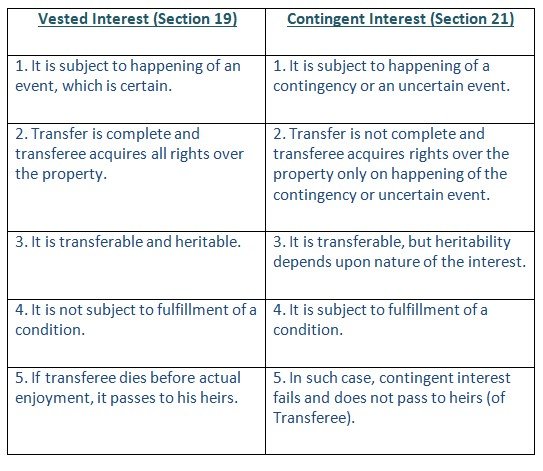
(1) Where an interest is vested, the transfer is complete and the transferee acquires all rights over the property, it is transferable and heritable.
(2) Where an interest is contingent, the transfer is not complete and the transferee acquires no right over the property. (Until and unless the contingency/uncertain event takes place).
Distinction between Vested Interest and Contingent Interest-

we believe in a holistic approach to legal education building not just lawyers, but socially conscious leaders of tomorrow.