CONSTRUCTION WITH REFERENCE TO OTHER STATUTES
Dr. Tanmoy Mukherji
Advocate
CONSTRUCTION WITH REFERENCE TO OTHER STATUTES-
Tanmoy Mukherji
Advocate
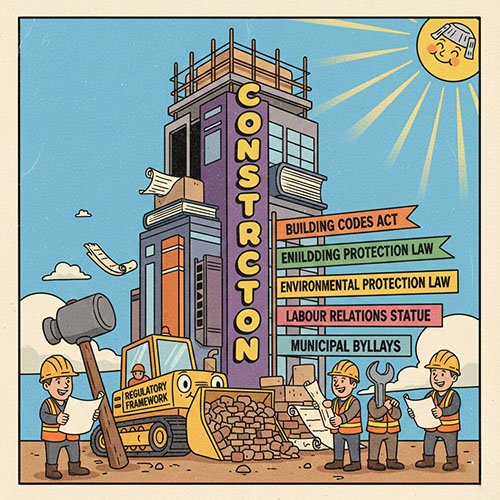
Interpretation of statutes does not take place in isolation. Courts often interpret a statute by referring to other statutes dealing with the same or allied subject-matter. This method ensures uniformity, coherence, and consistency in the legal system.
Construction with reference to other statutes may be studied under three heads:
Statutes in pari materia
Meaning-
The expression in pari materia means “upon the same matter or subject”. Statutes are said to be in pari materia when they:
→Relate to the same subject-matter,
→Form part of a common legislative scheme, or
→Have the same object and purpose, even if enacted at different times.
Rule of Interpretation-
Statutes in pari materia must be:
→Read together,
→Construed harmoniously, and
→Treated as if they are one statute.
→Words and expressions occurring in one statute may be interpreted in the same sense as used in the other.
Rationale-
The legislature is presumed to be consistent in its use of language while dealing with the same subject.
Reference Cases
Thompson v. Goold & Co. (1910)
The House of Lords held that statutes in pari materia should be taken together as forming one system, and interpreted consistently.
State of Madras v. A. Vaidyanatha Iyer (1958)
The Supreme Court held that the Prevention of Corruption Act, 1947 and the Indian Penal Code are in pari materia, and therefore provisions of IPC can be used to interpret the Act.
R.S. Nayak v. A.R. Antulay (1984)
The Court interpreted provisions of the Criminal Law Amendment Act by reading them along with the Code of Criminal Procedure, holding them to be in pari materia.
Commissioner of Income Tax v. Sun Engineering Works (1992)
The Supreme Court observed that provisions forming part of the same scheme must be read together to determine legislative intent.
Suresh Nanda v. CBI (2008)
The Court read provisions of the CrPC and Special Acts together to ensure harmonious construction.
Construction with reference to earlier statutes-
Meaning
Courts may refer to earlier statutes dealing with the same subject to:
→Trace legislative history,
→Apply the mischief rule (Heydon’s Rule),
→Understand the background and object of the legislation.
Rule-
When a later statute uses words identical to those in an earlier statute, it is presumed that the legislature intended the same meaning, unless a contrary intention appears.
Limitations-
→Earlier statutes cannot override the plain words of the new statute.
→They are only interpretative aids.
Reference Cases-
Bengal Immunity Co. Ltd. v. State of Bihar (1955)
The Supreme Court relied on earlier legislative enactments and constitutional debates to interpret Article 286 of the Constitution.
K.P. Varghese v. Income Tax Officer (1981)
The Court examined earlier provisions of the Income Tax Act to ascertain the true intent and object of Section 52.
R.M.D. Chamarbaugwalla v. Union of India (1957)
Earlier laws relating to gambling were referred to in order to understand the scope of the Prize Competitions Act.
Mahindra & Mahindra Ltd. v. Union of India (1979)
The Supreme Court held that when the same expression is used in successive statutes, it is presumed to carry the same meaning.
State of West Bengal v. Union of India (1963)
Legislative history and earlier statutes were considered to determine constitutional validity.
Construction with reference to subsequent statutes-
Meaning-
A subsequent statute or amendment may be used as an aid to interpretation of an earlier statute, particularly when:
→The later law is clarificatory or declaratory,
→There is ambiguity in the earlier statute,
→The legislature seeks to explain the earlier intent.
Rule-
A subsequent statute:
→May be a legislative exposition of the earlier law,
→Cannot change the meaning retrospectively unless expressly stated.
Reference Cases
Cape Brandy Syndicate v. IRC (1921)
It was held that later legislation may be referred to as a guide to the meaning of earlier legislation.
Municipal Committee, Amritsar v. Hazara Singh (1975)
The Supreme Court held that a subsequent amendment which is clarificatory can be used to interpret the original provision.
S.S. Gadgil v. Lal & Co. (1964)
Subsequent amendments were considered relevant for understanding legislative intent but not for retrospective operation.
Zile Singh v. State of Haryana (2004)
The Supreme Court held that clarificatory amendments are retrospective in nature and may be relied upon for interpretation.
Allied Motors (P) Ltd. v. CIT (1997)
The Court used a later amendment to explain the intention behind an earlier provision of the Income Tax Act.
Construction with reference to other statutes plays a vital role in statutory interpretation. It:
→Ensures uniformity and harmony in law,
→Helps courts discover legislative intent,
→Prevents contradictory interpretations,
while respecting the plain meaning rule.

we believe in a holistic approach to legal education building not just lawyers, but socially conscious leaders of tomorrow.
