Constitutional Provisions regarding Human Rights
Dr. Tanmoy Mukherji
[Advocate]
Constitutional Provisions regarding Human Rights-
Tanmoy Mukherji
[Advocate]
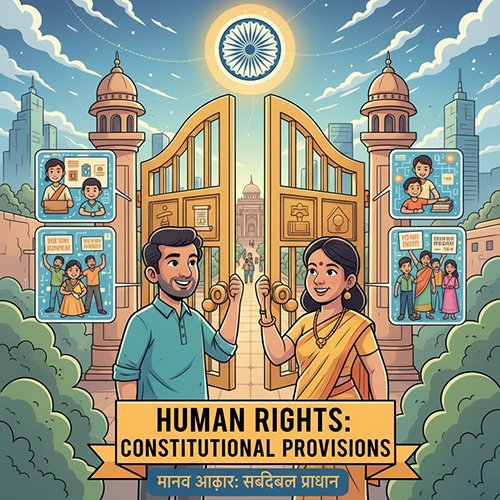
-Human rights are basic rights and freedoms that belong to all of us, from birth until death. They apply regardless of where you are from, what you believe or how you choose to live your life.
-Human rights are rights inherent to all human beings, regardless of race, sex, language, nationality, religion or any other status. Everyone is entitled to these rights without discrimination.
-The principle of universality of Human Right is the cornerstone of International Human Rights Law. The Universal Declaration on Human Rights adopted by the General Assembly on 10th December, 1948.
-India is the world's largest democracy. India has played a very significant role in the promotion of the cause of Human Right.
-Indian Constitution has incorporated a Declaration of Rights. India has not only incorporated a Bill of Rights in and elaborates its Constitution but efforts have been made to translate these in reality.
The Preamble and Human Rights-
The Preamble to the Constitution is of supreme importance and the Constitution should be read and interpreted in the light of the grand and noble vision expressed in the Preamble.
Fundamental Rights and Human Rights-
|
Brief Description of Provision |
UDHR |
Constitution of India
|
|
Equality and Equal protection before law |
Article-7 |
Article-14 |
|
Remedies for violation of Fundamental Rights |
Art-8 |
Art-32
|
|
Right to Life and Personal Liberty |
Art-3 |
Art-21 |
|
Protection in respect for conviction of offences |
Art-11(1) |
Art-20(1)
|
|
Right to property |
Art-17 |
Earlier a fundamental right under Art 31 |
|
Right to freedom of Conscience and to Practice, Profess and propagate |
Art-18 |
Art-25(1)
|
|
Freedom of Speech |
Art-19 |
Art-19(1)(a)
|
|
Equality in opportunity in public service |
Art-22 |
Art-16(1)
|
|
Right to Education |
Art-26(1) |
Art-21(A)
|
Many of the civil and political rights contained in the International Covenant on Political and Civil Rights, 1966 (ICCPR) are also contained in the Part-III of the Constitution of India.
|
Brief Description of Provision |
ICCPR |
Constitution of India
|
|
Right to Life and Liberty |
Art-6(1) and Art-9(1) |
Art-21
|
|
Prohibition of Trafficking and Forced Labour |
Art-8(3) |
Art-23
|
|
Protection against Detention in certain cases |
Art-9(2), Art-9(3), Art-9(4) |
Art-22
|
|
Freedom of Movement |
Art-12(1) |
Art-19(1)(d)
|
|
Right to Equality |
Art-14(1) |
Art-14
|
|
Right not to be compelled to be a witness against own. |
Art-14(3)(g) |
Art-20(3)
|
|
Protection against double jeopardy |
Art-14(7) |
Art-20(2)
|
|
Protection against ex post facto law
|
Art-15(1) |
Art-20(1)
|
|
Right to freedom of conscience and to practice, profess and propagate any religion
|
Art-18(1) |
Art 25(1), 25(2)(a)
|
|
Freedom of Speech and expression
|
Art-19(1), Art-19(2)
|
Art-19(1)(a)
|
|
Right to assembly peacefully
|
Art-21 |
Art-19(1)(b)
|
|
Right to form Union or Association
|
Art-22(1) |
Art-19(1)(c)
|
|
Equality in opportunity in public service
|
Art-25(c) |
Art-16(1)
|
|
Equality and equal protection before law and no discrimination on the basis of any ground such as race, sex, colour, language, religion etc.
|
Art-26 |
Art-14, Art-15(1)
|
|
Protection of Interest of Minorities.
|
Art-27 |
Art-29(1)- Art-30
|
Case Reference-
Jolly George vs. Bank of Cochin-
Krishna Iyer J. observed that, though a provision is present in ICCPR but not in Indian Constitution does not make the Covenant an enforceable part of "Corpus Juris" in India.
Directive Principles of State Policy and Human Rights-
The International Covenant on Economic social and cultural Rights (ICESCR) is a multilateral treaty which mainly focuses on social and cultural rights like food, health, education, shelter etc.
India ratified this covenant on 10th April, 1979. Most of the provisions in this covenant are found in part-IV (DPSPs) of the Indian Constitution.
|
Brief description of provisions
|
ICESCR
|
Constitution of India
|
|
Right to work
|
Art - 6(1)
|
Art-41
|
|
Equal pay for equal work
|
Art - 7(a)(i)
|
Art-39(d)
|
|
Right to living wage and decent standard of life
|
Art - 7(a)(ii) - 7(d)
|
Art-43
|
|
Human Conditions of work and maternity leave
|
Art - 7(b) ,Art-10(2)
|
Art-42
|
|
Opportunities to children for prevention against exploitation
|
Art-10(3)
|
Art-39(f)
|
|
. Improving public health and raising level of nutrition and standard of living |
Art-11
|
Art-47
|
|
Compulsory education for children
|
Art-13(2)(a)
|
Art-45
|
|
Protection of interest on minorities
|
Art-27
|
Art-29(1), Art-30
|
Case Reference-
Maneka Gandhi v. Union of India, AIR 1978, SC 597-
Justice Bhagwati observed that, the expression of personal liberty in Art 21 is of the widest amplitude and it covers a variety of rights contained in international laws of Human Rights.
|
Right |
Reference Case Laws
|
|
Right to live with human dignity |
PUCL and Another vs. case of Maharashtra.
|
|
Right to clean Air |
MC Mehta vs. Union of India (TAJ trapezier Matter).
|
|
Right to clean water |
MC Mehta vs. Union of India. |
|
Right to Freedom from noise pollution |
In Re Noise pollution.
|
|
Right to speedy trial |
Hussainara Khatun vs. Home Secretary, State of Bihar.
|
|
Right to livelihood |
Olgatellis vs. Bombay municipal corporation. |
|
Right to free legal aid |
Khatri vs. State of Bihar |
|
Right to food |
Kishen Patnayak vs. State of Orissa
|
|
Right to medical care |
Pt. Paramanan 'Katara' vs. Union of India. |
|
Right to clean environment |
Rural litigation and entitlement Kandra vs State of U.P
|
|
Right to privacy |
K.S. Dutta Swami vs. Union of India |

we believe in a holistic approach to legal education building not just lawyers, but socially conscious leaders of tomorrow.
