CONDITIONS PRECEDENT AND CONDITIONS SUBSEQUENT
Transfer of Property Act, 1882
Dr. Tanmoy Mukherji
[Advocate]
CONDITIONS PRECEDENT AND CONDITIONS SUBSEQUENT [Conditional Transfer: Sections 25-34]-
Tanmoy Mukherji
[Advocate]
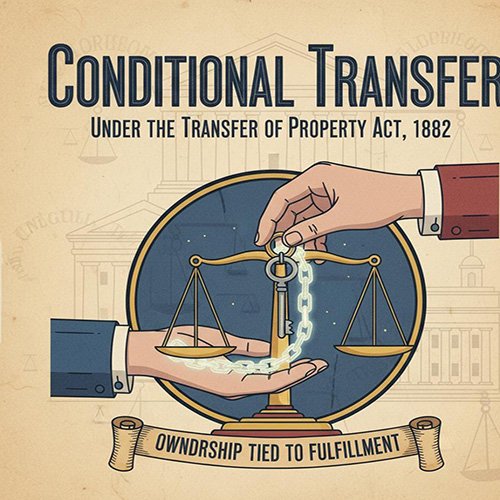
Every person, who is competent to contract (under Section 11 of the Indian Contract Act, 1872) is also competent/entitled to transfer his/her property. When he wants to transfer the property upon fulfillment of a condition/obligation, such transfer is called 'Conditional Transfer'. The conditional transfer may take place in two ways, namely:
1. Condition Precedent; and
2. Condition subsequent.
Sections 25 to 34 of the Transfer of Property Act, 1882 lay down the provisions relating to Conditional Transfer. Section 25 provides for the general rule of all kinds of conditional transfers. According to Section 25, where the transfer of property is dependent upon a condition, the fulfillment of which is impossible or forbidden by law, such transfer is declared void. Sections 26 and 27 deal with the condition precedent and Sections 28 to 34 deal with the condition subsequent.
CONDITION PRECEDENT [Sections 25-27]-
Condition precedent means, a condition to be performed before an interest arises (When a property is transferred, right/interest in property gets transferred). A condition precedent is one, which the vesting of a right until the happening of a specified event, i.e. condition. Sections 25 to 27 of the Transfer of Property Act, 1882 deal with Condition Precedent.
Section 25 lays down the general rule that, transfer takes effect, if a condition precedent is satisfied. If the condition precedent is-
a) impossible
b) forbidden by law; or
c) of such a nature that, if permitted, would defeat the provisions of any law; or
d) fraudulent; or
e) involves or implies injury to the person or property of another; or
f) the court regards it as immoral or opposed to public policy.
Such transfer is void/invalid.
Section 25 runs as follows-
An interest created on a transfer of property and dependent upon a condition fails if the fulfillment of the condition is impossible, or is forbidden by law, or is of such a nature that, if permitted, it would defeat the provisions of any law, or is fraudulent, or involves or implies injury to the person or property of another, or the Court regards it as immoral or opposed to public policy.
Illustrations:
(1) A lets a farm to B on condition that he shall walk a hundred miles in an hour. The lease is void.
(2) A gives Rs.500 to B on condition that he shall marry A's daughter C. At the date of the transfer C was dead. The transfer is void.
(3) A transfers Rs.500 to B on condition that she shall murder C. The transfer is void.
(4) A transfers Rs.500 to his niece C, if she will desert her husband. The transfer is void.
Fulfillment of condition precedent: Section 26 refers to conditional transfer to one person coupled with transfer to another on failure of prior disposition. According to Section 26, the condition is deemed to have been fulfilled if it is substantially complied with.
Section 26 runs as follows-
Where the terms of a transfer of property impose a condition to be fulfilled before a person can take an interest in the property, the condition shall be deemed to have been fulfilled if it has been substantially complied with.
Illustrations:
(a) A transfers Rs-5,000 to B on condition that he shall marry with the consent of C, D and E. E dies. B marries with the consent of C and D. B is deemed to have fulfilled the condition.
(b) A transfers Rs-5, 000 to B on condition that he shall marry with the consent of C, D and E. B marries without the consent of C, D and E, but obtains their consent after the marriage. B has not fulfilled the condition.
Section 27 relates to conditional transfer to one person coupled with transfer to another on failure of prior disposition. It runs as follows-
Where, on a transfer of property, an interest therein is created in favor of one person, and by the same transaction an ulterior disposition of the same interest is made in favor of another, if the prior disposition under the transfer shall fail, the ulterior disposition shall take effect upon the failure of the prior disposition, although the failure may not have occurred in the manner contemplated by the transferor.
But, where the intention of the parties to the transaction is that the ulterior disposition shall take effect only in the event of the prior disposition failing in a particular manner, the ulterior disposition shall not take effect unless the prior disposition fails in that manner.
Illustrations:
(a) A transfers Rs.500 to B on condition that he shall execute a certain lease within three months after A's death, and, if he should neglect to do so, to C. B dies in A's lifetime. The disposition in favor of C takes effect.
(b) A transfers property to his wife but, in case she should die in his lifetime, transfer to B that which he had transferred to her. A and his wife perish together, under circumstances which make it impossible to prove that she died before him. The disposition in favour of B does not take effect.
(P.S- Sections 25 and 26 are more important for condition precedent).
Characteristics of Condition Precedent:
Following are the characteristic features of the condition precedent.
(i) The condition shall be fulfilled before the property/estimate is vested in the transferee;
(ii) The estate does not vest in the transferee until and unless, the condition is fulfilled;
(iii) The condition should not be declared void under Section 25;
(iv) The condition is deemed to be fulfilled, if it is substantially complied with under Section 26.
CONDITION SUBSEQUENT [Sections 28-34]-
A condition subsequent is one, which destroys or divests upon the happening of an event. It literally means, a condition, which has to be fulfilled after an interest is created upon the transfer of a property. Sections 28 to 34 lay down the provisions relating to condition subsequent.
Section 28 deals with conditional limitation. It refers to ulterior transfer conditional on happening or not happening of specified event. It runs as follows-
On a transfer of property an interest therein may be created to accrue to any person with the condition superadded that in case a specified uncertain event shall happen such interest shall pass to another person, or that in case a specified uncertain event shall not happen such interest shall pass to another person. In each case the dispositions are subject to the rules contained in Sections 10, 12, 21, 22, 23, 24, 25 and 27.
An interest in the property transferred may be created in favor of any person with a condition that in case a specified uncertain event shall not happen such interest shall pass to another person. For instance, A transfers Rs.5000 to B with the condition that B joins the bar within three years from the date of the transfer and in case he does not join within the said period, the property is to go to C. In case B does not join the bar, C gets Rs.5000. In this illustration the transfer, in favor of C is an ulterior transfer, and it takes effect on the failure of the prior transfer. As regards the prior interest, the condition is a condition subsequent but as regards the ulterior disposition, it is a condition precedent.
The ulterior transfer (in the above illustration the transfer to C) is subject to the rules contained in Sections 10, 12, 21, 22, 23, 24, 25 and 27.
Illustrations:
1. A transfers his farm to B and then to C without power of alienation. The restriction is void under Section 10.
2.A transfers his land to B, and if B becomes insolvent, to C. The condition is void under Section 12.
3. A transfers his field to B and in case of B's death without issue to C. C's interest is contingent (Section 21).
4. A transfers his field to B and on B's death to such children of C who attain the age of 18. All the children of C who are alive at B's death have an interest as laid down in Section 22.
5. A transfers his field to B for life and on B's death to C at the age of 18. C does attain the age of 18 until 6 months after B's death. C's interest fails under Section 23.
6. A transfers his field to B and on B's death without issue, to the sons of C or the survivor of them. The sons of C who survive B become entitled to it under Section 24.
7. A transfers his field to B for life on the condition that B murders C and then after B's death to D. The transfer fails in both cases under Section 25.
Section 29 deals with fulfillment of condition subsequent. It runs as follows-
An ulterior disposition of the kind contemplated by the last preceding section cannot take effect unless the condition is strictly fulfilled.
Illustrations:
1. A field is transferred to A with a proviso that if he married without the consent of B, C and D, the field will go to E. D dies. Even if A married without the consent of B and C, the gift to E does not take effect.
Section 30 deals with the effect of the invalidity of the ulterior disposition on the prior one and it provides that the prior disposition is not affected by the invalidity of the ulterior disposition. An ulterior disposition may be invalid because the condition on which it is dependent is illegal, too vague, impossible, and too remote, opposed to the rule laid down in Section 13 or is otherwise inoperative. It reads as follows-
If the ulterior disposition is not valid, the prior disposition is not affected by it-
Illustration:
A transfers a farm to B for her life, and, if she does not desert her husband to C. B is entitled to the farm during her life as if no condition had been inserted.
Section 31 deals with a condition subsequent, which terminates an interest and reverts in the grantor. Section 31 provides for condition that transfer shall cease to have effect in case specified uncertain event happens or does not happen. It runs as follows-
Subject to the provisions of Section 12, on a transfer of property an interest therein may be created with the condition superadded that it shall cease to exist in case a specified uncertain event shall happen, or in case a specified uncertain event shall not happen.
Illustrations:
1. A transfers a farm to B for his life, with a proviso that, in case B cuts down a certain wood, the transfer shall cease to have any effect. B cuts down the wood. He loses his life interest in the farm.
Section 32 speaks about invalid condition subsequent. According to Section 32, a condition, which would be void under Section 95 as a condition precedent is void under Section 32 as a condition subsequent. It runs as follows:
In order that a condition that an interest shall cease to exist may be valid, it is necessary that the event to which it relates be one which could legally constitute the condition of the creation of an interest.
Section 32 provides a test for finding what conditions subsequent is valid. Following are the conditions void-
(i) Condition void for uncertainty.
(ii) Condition opposed to public policy.
(iii) Condition in restraint of marriage.
(iv) Condition, which is immoral.
(v) Condition, which is impossible for performance.
(vi) Condition as to Residence, where there is uncertainty as to it.
Section 33 provides that, when no time is fixed for the performance of a condition subsequent, it is broken not only when the person does an act, which renders the performance impossible, but also, when he does an act, by which the performance is definitely postponed. Section 33 runs as follows:
-Where, on a transfer of property, an interest therein is created subject to a condition that the person taking it shall perform a certain act, but no time is specified for the performance of the act, the condition, is broken when he renders impossible, permanently or for an indefinite period, the performance of the act.
-Finally Section 34 speaks about the time for performance specified. It lays down that if the performance of a condition whether subsequent or precedent is prevented by a person interested in its non-fulfillment, the delay is executed and the condition is discharged.
Section 34 is based on two maxims: fraud dolus nemin patrocinari decent (fraud and deceit ought not to benefit any person) and, nullus commodum capere potest de injuria sua propria (no one can take advantage of his own wrong).
This Section covers two classes of cases:
1. Where a time is specified for the performance of the act constituting the condition of the transfer and the fulfillment of the condition is prevented by the fraud of the person directly benefited by the non-fulfillment of the condition.
2. Where no time is specified for the performance of such act and the fulfillment of the condition is rendered impossible or is indefinitely postponed by the fraud of the person interested in the non-fulfillment of the condition.
Section 34 runs as follows:
Where an act is to be performed by a person either as a condition to be fulfilled before an interest created on a transfer of property is enjoyed by him, or as a condition on the non-fulfillment of which the interest is to pass from him to another person, and a time is specified for the performance of the act, if such performance within the specified time is prevented by the fraud of a person who would be directly benefited by non-fulfillment of the condition, such further time shall as against him be allowed for performing the act as shall be requisite to make up for the delay caused by such fraud. But if no time is specified for the performance of the act, then, if its performance is by the fraud of a person interested in the non-fulfillment of the condition rendered impossible or indefinitely postponed, the condition shall as against him be deemed to have been fulfilled.
Illustration: A testator directed that if any of the female members of his family lived for more than three months at any place other than a holy place they would forfeit their interest under his will. The forfeiture was not incurred when they were forcibly removed by their relation.
Distinction between Condition Precedent and Condition Subsequent-
Following are the notable points of distinction between Condition Precedent and Condition Subsequent.
|
Condition Precedent
|
Condition Subsequent
|
|
In condition precedent, the estate is not vested in the grantee until the condition is performed/fulfilled.
|
In condition subsequent, the estate vests in the grantee immediately and remains in the grantee till the condition is broken.
|
|
It does not require strict compliance. Substantial compliance is enough/sufficient.
|
It requires strict compliance or strict fulfillment of the condition is necessary.
|
|
If the performance of the condition precedent is impossible, both the condition precedent and the estate limited upon it are void.
|
If the performance is impossible, the condition subsequent fails, and the previous estate becomes indefeasible.
|
|
If the condition precedent is illegal, the property limited upon it, fails.
|
If condition subsequent is illegal; the previous estate becomes indefeasible and the condition is ignored.
|
|
By the performance of the condition an estate not previously vested, becomes vested.
|
By the performance of the condition, an estate previously vested becomes divested.
|

we believe in a holistic approach to legal education building not just lawyers, but socially conscious leaders of tomorrow.
