A comparative discussion between the British and American Cabinet-
Dr. Tanmoy Mukherji
Advocate
A comparative discussion between the British and American Cabinet-
Tanmoy Mukherji
Advocate
Introduction
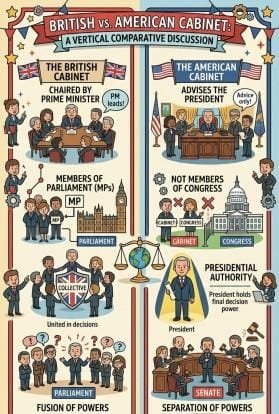
The Cabinet is the core executive authority in both Great Britain and the United States. It plays an important role in policy formulation and administration. However, the British and American Cabinets differ fundamentally in nature, powers, and functioning because Britain follows a parliamentary system of government, whereas the United States follows a presidential system. These structural differences deeply influence the position of the Cabinet in both countries.
1. Nature of the Political System
In Britain, the Cabinet functions under a parliamentary form of government where the executive and legislature are closely connected. The Cabinet emerges from Parliament and remains accountable to it.
In contrast, the American Cabinet operates under a presidential system where a strict separation of powers exists between the executive and the legislature. The Cabinet is not a part of Congress and functions independently of it.
2. Constitutional Position
The British Cabinet does not find mention in any written constitution and owes its existence to long-established constitutional conventions. Despite this, it is the most powerful executive body in the country. Ivor Jennings described it as “the pivot of the whole political system.”
On the other hand, the American Cabinet has indirect constitutional recognition under Article II of the U.S. Constitution, which authorizes the President to seek written opinions from the heads of executive departments. However, the Constitution does not establish the Cabinet as a collective decision-making body.
3. Composition
The British Cabinet is composed of senior political leaders who are members of Parliament, mainly from the House of Commons and a few from the House of Lords. They are chosen for their political experience and leadership qualities.
In contrast, the American Cabinet consists of the heads of executive departments, known as Secretaries, who are appointed primarily for their administrative and technical expertise. Members of the American Cabinet cannot be members of Congress.
4. Appointment and Removal
In Britain, Cabinet ministers are appointed by the Prime Minister and formally approved by the Monarch. They may be removed by the Prime Minister or compelled to resign collectively if the Cabinet loses the confidence of Parliament.
In the United States, Cabinet members are appointed by the President but require confirmation by the Senate. They hold office at the pleasure of the President and may be removed individually by him.
5. Leadership and Role of the Head
The British Cabinet is led by the Prime Minister, who is often described as “first among equals.” Though the Prime Minister is dominant, Cabinet decisions are taken collectively.
In contrast, the American Cabinet is dominated by the President, who is both Head of State and Head of Government. Cabinet members are subordinate advisors. Lord Bryce remarked that the American Cabinet is “a group of servants rather than colleagues.”
6. Responsibility
One of the most important features of the British Cabinet is the principle of collective responsibility. All ministers must publicly support Cabinet decisions, and failure to do so may result in resignation. The Cabinet is responsible to Parliament, particularly the House of Commons.
In contrast, the American Cabinet is not collectively responsible to Congress. Cabinet members are responsible only to the President, and Congress has no power to dismiss them.
7. Role in Law-Making
The British Cabinet plays a decisive role in legislation. It initiates bills, controls parliamentary time, and ensures the passage of laws through Parliament. In practice, Parliament often acts under Cabinet leadership.
In contrast, the American Cabinet has no direct role in law-making. Cabinet members cannot introduce bills in Congress and may only assist the President in influencing legislative opinion.
8. Relationship with Legislature
In Britain, ministers regularly participate in parliamentary debates and are subject to questioning by members of Parliament. This ensures accountability and transparency.
In the United States, Cabinet members are completely excluded from Congress and cannot participate in legislative debates. Though they may appear before congressional committees, they are not directly answerable to Congress.
9. Unity and Solidarity
The British Cabinet operates on the principle of secrecy and unity. Cabinet discussions are confidential, and decisions once taken are binding on all members.
In the American system, there is no such principle of unity. Cabinet members may express differing opinions publicly, and disagreement does not require resignation.
10. Stability and Tenure
The tenure of the British Cabinet depends on the confidence of the House of Commons and may be uncertain. A vote of no-confidence can lead to the resignation of the entire Cabinet.
In contrast, the American Cabinet enjoys stability because the President has a fixed tenure, and Cabinet members usually serve for the duration of the President’s term.
Conclusion
To conclude, the British Cabinet is a powerful, collective, and politically responsible body that dominates the executive and legislative processes. The American Cabinet, on the other hand, is mainly an advisory body with limited political influence, functioning under the dominance of the President. These differences clearly reflect the contrasting principles of the parliamentary and presidential systems of government.

we believe in a holistic approach to legal education building not just lawyers, but socially conscious leaders of tomorrow.
