Circumstantial Evidence
Dr. Tanmoy Mukherji
[Advocate]
Circumstantial Evidence-
Tanmoy Mukherji
[Advocate]
Meaning-
Circumstantial Evidence = Evidence of surrounding circumstances that indirectly prove a fact in issue.
Unlike direct evidence (eyewitness), it relies on inference.
Example- Seeing a person entering a room with a knife → later finding a dead body → inference of guilt.
Legal Basis-
BSA does not separately define circumstantial evidence.
-Section 2(e) BSA (Section 3 IEA) (Evidence defined),
- Section 119 BSA (Section 114 IEA) (Court may presume),
- Section 109 BSA (Section 106 IEA) (Facts within knowledge) form its basis.
Courts have evolved strict principles to ensure fair use.
Significance-
1. Often the only evidence available-
e.g., murder inside the house, conspiracy, corruption, dowry death.
2. Conviction possible solely on circumstantial evidence, if principles satisfied.
3.Equal weight as direct evidence –
No legal distinction in probative value.
4.Prevents miscarriage of justice –
Protects against baseless suspicion.
5. Acts as corroborative evidence –
Strengthens direct testimony.
Golden Principles (Panchsheel of Circumstantial Evidence)-
Laid down in Sharad Birdichand Sarda v. State of Maharashtra (1984) 4 SCC 116-
1. Circumstances must be fully established.
2. They must be consistent only with guilt of accused.
3. They must be of a conclusive nature.
4. They must exclude every other hypothesis except guilt.
5. There must be a complete chain of evidence.
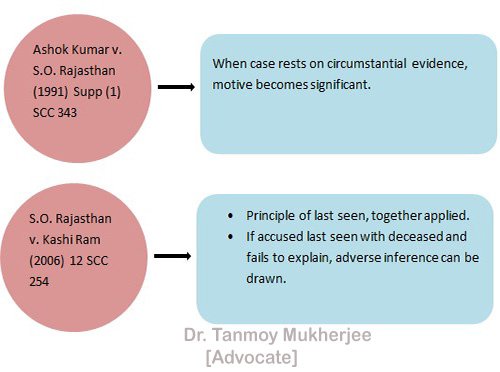
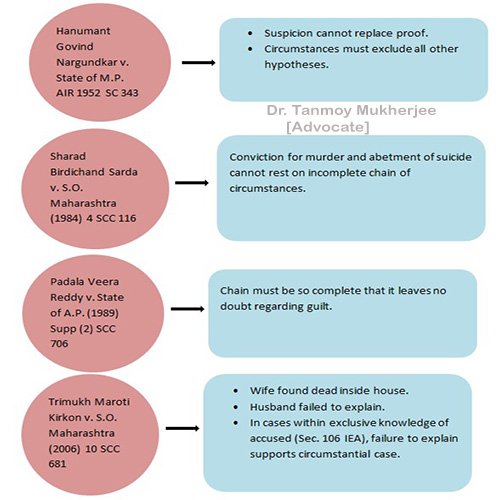
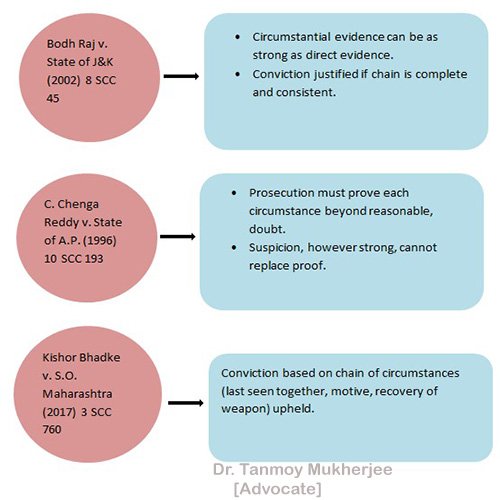
Landing case laws-
Circumstances Relied on by Courts-
|
Motive |
Why would accused commit? |
|
Last Seen Theory |
Accused last seen with deceased.
|
|
Recovery of weapon/ Stolen property |
Proviso 2 Section 23 BSA,2023 ( Section 27 IEA)
|
|
Conduct of accused before/after offence |
Section 6 BSA (sec- 8 IEA)
|
|
False defence |
False explanation by accused.
|
|
Medical/Forensic evidence |
Bloodstains/fingerprints, DNA.
|
Case Principle-
Homumant Govind Nargundkar v. State of M.P. (1952)
→ Circumstances must exclude all hypotheses except guilt.
Sharad Birdichand Sarda v. State of Maharashtra (1984)
→ Five golden principles (Panchsheel).
Padala Veera Reddy v. State of A.P. (1989)
→ Chain must be complete.
C. Chenga Reddy v. State of A.P. (1994)
→ Suspicion ≠ Proof
Bodh Raj v. State of J&K (2002)
→ Circumstantial = direct evidence.
Trimukh Maroti Kirkan v. State of Maharashtra (2006)
→ Sec. 106 IEA → Failure to explain = adverse inference.
State of Rajasthan v. Kashi Ram (2006)
→ Last seen theory accepted.
Kishore Bhadke v. State of Maharashtra (2017)
→ Conviction upheld based on complete Chain.
- Circumstantial evidence is crucial in criminal law where direct eyewitnesses are absent. If the chain of circumstances is complete and satisfies the five golden principles, conviction can safely rest on it.

we believe in a holistic approach to legal education building not just lawyers, but socially conscious leaders of tomorrow.