Charge under Criminal Law-
Dr. Tanmoy Mukherji
Advocate
Charge under Criminal Law-
Tanmoy Mukherji
Advocate
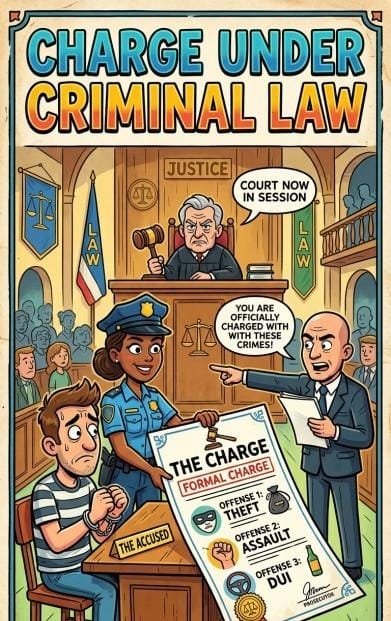
CHARGE UNDER BNSS, 2023 is a formal accusation framed by the Court against an accused.
Meaning of Charge-
A charge is the formal and precise accusation framed by a criminal court against an accused, stating the offence for which the accused is required to face trial.
Statutory basis-
Sections 234 – 247 of the Bharatiya Nagarik Suraksha Sanhita, 2023 (BNSS)
Why a Charge is Important-
→Gives clear notice of the accusation
→Enables the accused to prepare defence
→Defines the scope of the trial
→Prevents surprise or prejudice
→Ensures a fair trial
→Assists the court in focusing on real issues.
Essential Elements of a Charge-
→Offence alleged (use the name, if any)
→Relevant statutory provision (section of law)
→Time of offence
→Place of offence
→Person against whom / property involved
→Manner of commission (where necessary)
→Sufficient particulars to inform and enable the accused to defend.
Charge vs Charge-sheet vs FIR-
|
Basis
|
FIR |
Charge-sheet / Police Report |
Charge |
|
Prepared by
|
Informant / Police
|
Police (Investigating Agency)
|
Court
|
|
Stage
|
Beginning of process
|
After investigation
|
Before trial
|
|
Nature
|
Information of cognizable offence
|
Investigative conclusion
|
Formal judicial accusation
|
|
Purpose
|
Sets law in motion
|
Places evidence before court
|
Specifies accusation to be tried
|
|
Determines guilt?
|
No
|
No
|
No
|
|
Role in trial
|
Not a charge
|
Not a charge
|
Defines the offence to be tried.
|
Charge-sheet is prepared by the police; charge is framed by the court. They are not the same thing.
Stages from Offence to Trial-
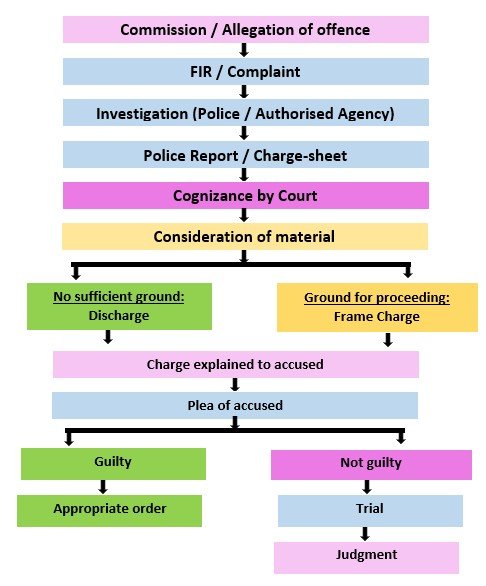
Standard for Framing Charge-
|
At charge stage |
At trial stage |
|
→Court considers whether there is a strong suspicion supported by material.
|
→Evidence is tested in open court.
|
|
→It does not conduct a full trial.
|
→Guilt must be proved beyond reasonable doubt.
|
|
→It does not weigh evidence as in final adjudication.
|
→Detailed appreciation of evidence. |
|
→It sees whether there is a prima facie case to proceed.
|
→Final determination of guilt or innocence.
|
“Framing of charge does not mean the accused is guilty. It only means that there is sufficient ground to proceed.”
Example of a Charge (Simplified)-
“That you, A, on 15 March 2025 at Kolkata, did intentionally cause the death of B by stabbing him with a knife, and thereby committed the offence of murder punishable under Section 103 of the Bharatiya Nyaya Sanhita, 2023.”
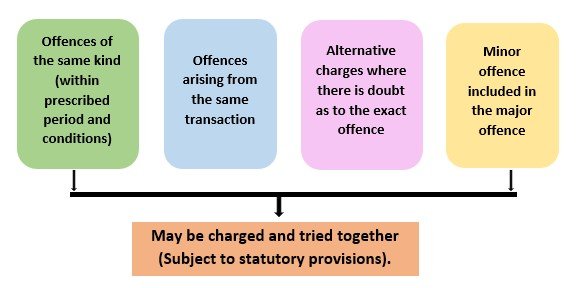
Joinder of Charges-
Common Errors and Their Effect-
|
Incorrect date or place: |
Not fatal if no prejudice is caused. |
|
Omission of a detail: |
Valid if charge still sufficiently informs the accused.
|
|
Mis-description of section: |
Not fatal if the substance of the offence is clear.
|
|
Defect causing confusion: |
May vitiate the proceedings if prejudice is shown.
|
Alteration or Addition of Charge-
→Court may alter or add to a charge at any time before judgment.
→Accused must be informed and given opportunity to defend.
→If necessary, witnesses may be recalled or re-examined.
→It should not result in prejudice to the accused or prosecution.
Case Illustrations-
|
Murder case: |
Investigation → charge-sheet → court frames charge → trial. Framing charge ≠ guilt.
|
|
Discharge vs charge: |
No material → discharge. Strong material → charge framed.
|
|
Alteration of charge: |
New evidence during trial → court may alter charge → accused given opportunity.
|
|
Connected offences: |
House trespass + assault + theft in same occurrence → may be tried together.
|
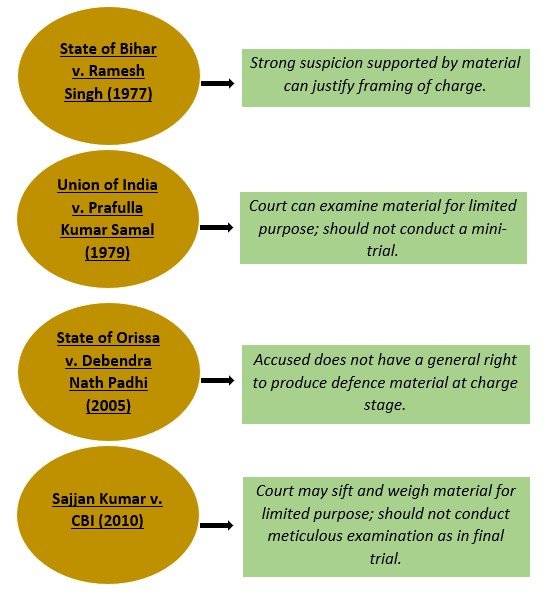
Important Judicial Decisions-
Significance-
→A charge is a formal accusation framed by the court.
→It gives the accused clear notice of the case to be met.
→Charge and charge-sheet are different.
→Framing of charge is based on sufficient material, not proof beyond reasonable doubt.
→Court may join, alter or add charges in appropriate cases.
→Not every error in a charge is fatal; the key question is prejudice.
→Fair framing of charge is essential for a just trial.

we believe in a holistic approach to legal education building not just lawyers, but socially conscious leaders of tomorrow.
