Basic Features of Indian Economy
Dr. Tanmoy Mukherji
Advocate
Basic Features of Indian Economy-
Tanmoy Mukherji
Advocate
INTRODUCTION-
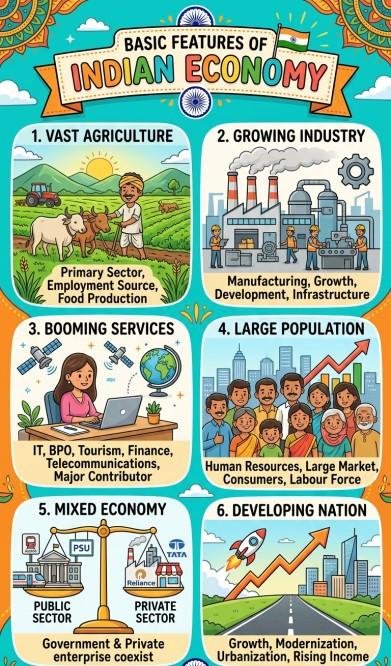
The Indian Economy is a mixed, developing and emerging economy with a blend of traditional and modern features. It is characterized by diversity, complexity and dynamic changes.
MIXED ECONOMY-
→Coexistence of public sector and private sector.
→Both government and market forces play an important role.
→Example: Railways (Public) Reliance (Private)
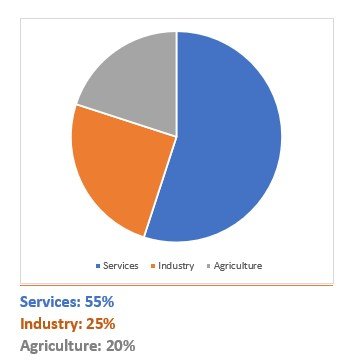
SECTOR-WISE GDP SHARE (Approx.)-
A. STRUCTURAL FEATURES-
1.Mixed Economy – Coexistence of public and private sectors.
2.Coexistence of Sectors – Agriculture, Industry and Services exist together.
3.Dominance of Service Sector – Contributes more than 50% of GDP.
4.Agricultural Dependence – Large population depends on agriculture.
5.Small Land Holdings – Fragmentation reduces productivity.
6.Dual Economy – Modern sector and traditional sector coexist.
7.Unorganised Sector Dominance – Large informal workforce.
8.Labour-Intensive Economy – High reliance on human labour.
9.Capital Scarcity – Lack of sufficient capital formation.
10.Low Industrial Base (Historically) – Improving after liberalization.
B. DEVELOPMENTAL FEATURES-
11.Developing Economy – Not fully developed, still progressing.
12.Low Per Capita Income – Compared to developed nations.
13.High Population Growth – Creates pressure on resources.
14.Poverty – Significant population below poverty line.
15.Unemployment – Disguised, seasonal and structural.
16.Income Inequality – Gap between rich and poor.
17.Regional Imbalance – Unequal development across states.
18.Human Development Issues – Education, health, nutrition challenges.
19.Low Productivity – Especially in agriculture.
20.Underutilization of Resources – Inefficient allocation.
C.POLICY FEATURES-
21.Economic Planning – Five Year Plans (earlier).
22.Liberalisation (1991 Reforms) – Reduced government control.
23.Privatisation – Increasing role of private sector.
24.Globalisation – Integration with world economy.
25.Welfare State – Focus on social justice.
26.Government Intervention – Regulation in key sectors.
27.Subsidy System – For farmers, poor, etc.
28.Public Distribution System (PDS) – Food security.
29.Inclusive Growth Policy – Growth with equality.
30.Digital Economy Push – Digital India, UPI, e-governance.
D. AGRICULTURAL FEATURES-
31. Monsoon Dependence – Agriculture depends on rainfall.
32. Low Irrigation Coverage – Not fully irrigated.
33. Traditional Methods – Lack of modern technology.
34. Green Revolution Impact – Increased food production.
35. Seasonal Employment – Agriculture not year-round.
E. INDUSTRIAL FEATURES-
36. MSME Dominance – Small-scale industries important.
37. Industrial Growth Post-1991 – Rapid industrialization.
38. Make in India Initiative – Boost manufacturing.
39. Infrastructure Deficit – Power, transport, and logistics issues.
40. Public Sector Undertakings – Key industries controlled by govt.
F. SERVICE SECTOR FEATURES-
41. IT Sector Growth – Major contributor (Infosys, TCS).
42. Outsourcing Hub – BPO, KPO services.
43. Tourism Industry – Growing sector.
G. SOCIAL FEATURES-
44. Demographic Dividend – Young population advantage.
45. Literacy Improvement – Increasing education levels.
46. Gender Inequality – Still present.
47. Urbanization – Migration to cities.
48. Rural-Urban Divide – Income & facility gap.
H. EXTERNAL SECTOR FEATURES-
49. Foreign Trade Growth – Export-import expansion.
50. Foreign Direct Investment (FDI) – Increasing inflows.
51. Balance of Payment Issues – Occasional deficits.
52. Remittance Economy – NRIs send money.
I. MODERN FEATURES-
53. Startup Ecosystem – Rapid growth of start-ups and unicorns.
54. Digital Payments Revolution – UPI, mobile banking.
55. Financial Inclusion – Jan Dhan Yojana, Aadhaar, DBT.
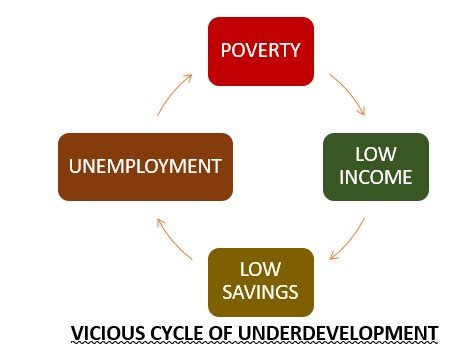
CHALLENGES CYCLE-
The graphic shows a circular relationship between:

we believe in a holistic approach to legal education building not just lawyers, but socially conscious leaders of tomorrow.
