ATTESTED OR ATTESTATION
Transfer of Property Act, 1882
Dr. Tanmoy Mukherji
Advocate
ATTESTED OR ATTESTATION [Section 3 of the Transfer of Property Act, 1882]-
Tanmoy Mukherji
Advocate
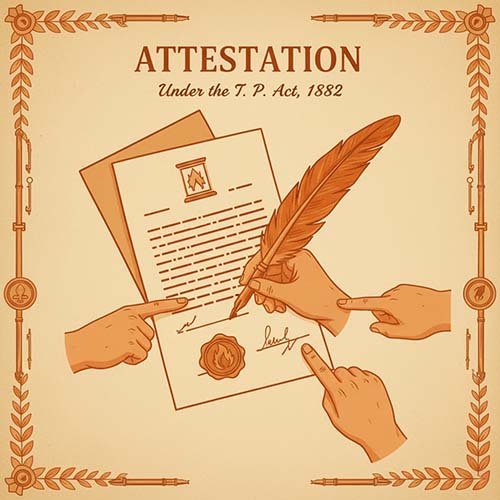
Meaning-
The expression 'Attestation' means "to sign and witness the fact of execution of a document by the executant." 'Attest' means to testify a fact, to bear witness to fact. Attestation in relation to a document signifies the fact of authentication of the signature of the executant of that document by the attestor by putting down his own signature on the document in testimony of the fact of its execution. The term 'attested' in Section 3 of the T.P.Act means that a person has signed the document by way of testimony of the fact that he saw it (document) executed.
It runs as follows-
'Attested', in relation to an instrument, means and shall be deemed always to have meant, attested by two or more witnesses each of whom has seen the executant sign or affix his mark to the instrument, or has seen some other persons sign the instrument in the presence and by the direction of the executant, or has received from the executant a personal acknowledgment of his signature or mark, or of the signature of such other persons, and each of whom, has signed the instrument in the presence of the executant, but it shall not be necessary that more than one of such witnesses shall have been present at the same time, and no particular form of attestation shall be necessary.
-Attestation is an important formality in execution of transfer. All transfers do not require attestation. It is necessary in certain cases like gift, mortgage etc., and optional in case of sale, lease etc.
- Attestation is valid and complete, when two witnesses sign the instrument. The object of attestation is to ensure that there is no fraud or vitiating circumstance in the execution of a document. The Transfer of Property (Amending) Act XXVII of 1926, added a definition of 'attested' in Section 3 of the Transfer of Property Act in terms of the definition of Indian Succession Act, thus sanctioning attestation on acknowledgement of execution. So, Act X of 1927 amended the definition by adding after the word 'attestation' means the words 'and shall be deemed always to have meant'. This amendment makes it clear that the definition of 'attestation' has retrospective operation. Shamu vs. Patter's case is no longer good law.
Essentials or requisites:
An attestation to be valid, the following conditions are to be satisfied-
1. Definition under section is confined only to non-testamentary instrument. It will not apply to wills etc.
2. Minimum two attesting witnesses are needed. Maximum is not mentioned.
3. Three modes of attestation are recognized, e.g-
(i) Each sees the executant signing or fixing mark; or
(ii) Each sees some other person signing in the presence and by the direction of the executant; or
(iii) Each has received from the executant the personal acknowledgement
(a) Of executant's sign,
(b) Of Executant's mark
(c) Sign of one who signed for the executant in his presence and by his direction.
4. Each witness signs the instrument in presence of executant.
5. Presence of both on all attesting witnesses one and at the same time is not essential.
6. No particular form of attestation is prescribed.
Qualification of Attestor-
An attestor must be a major, and a person of sound mind. He may be literate or illiterate. A party to the deed should not attest. The Sub Registrar of Stamps and Registration is not competent person to attest the document.
Effect of invalid attestation-
Where attestation is compulsory, it must be attested properly. Otherwise, it is ineffective. According to Section 59 of the Act if a mortgage deed is not duly attested, it cannot be enforced in a Court.
Reference Cases-
Kundan Lal vs. Mushar (5 PC 207) –
In this case the executant was a pardanashin lady and was sitting behind a thin curtain when the attestators signed. The Privy Council held that the attestation was valid as the executant, if so minded, could have seen the witnesses, even if she did not actually see them, through the curtain. It is tantamount to say that an attesting witness should sign his name in the presence of the executant.
Rao Ganga Prasad Singh vs Isturi Prasad Singh (34 MILJ 545 (PC) - In this case deed of mortgage was signed behind the purdah and was brought to the witness bearing a signature which the son of the lady said was her signature. The Privy Council held that there was no valid attestation because for a valid attestation, the attestator must have actually witnessed execution or received from the executant an acknowledgement of execution.
Similarly in Padarath Halwai vs. Ram Narayan Upadhya (37 All 474 (PC), the hand of the executant who was behind the purdah was seen and her voice was heard and recognized by the witness. It was held that the attestation was valid.
Sant Lal Mahtan vs. Kamala Prasad (1951) –
In this case a mortgage-deed was written by the scriber on 8-4-1927. On the same day, the mortgagor did not sign. But the attesting witness signed on the mortgage deed on 8-4-1927. The mortgagor signed the mortgage-deed on 12-4-1927. The Supreme Court held that it was not a valid attestation. The attesting witness should sign after the executant signed, only then it would become valid attestation. Otherwise, there is no value for the attestation in the eye of the law.
Distinction between English Law and Indian Law-
Following are the notable points of distinction between English Law and Indian Law with regard to the rules of attestation-
|
English Law
|
Indian Law
|
|
1. English Law insists on the presence of two witnesses at the time of attestation.
|
1. The presence of two witnesses is not compulsory/necessary at the time of attestation.
|
|
2. The rules of attestation are rigid/strict.
|
2. The rules of attestation are flexible/liberal.
|

we believe in a holistic approach to legal education building not just lawyers, but socially conscious leaders of tomorrow.
