Asylum
International Law
Dr. Tanmoy Mukherji
Advocate
Asylum (International Law)-
Tanmoy Mukherji
Advocate
In International law, asylum is the protection granted by State to a foreign national who seeks refuge from persecution, threats of life, or serious harm in their country of origin. It represents the intersection of state sovereignty (the right to control admission) and protection obligations in international law (to protect human rights and refugees).
Although there is no universal treaty that establishes a right to be granted asylum, international law recognizes:
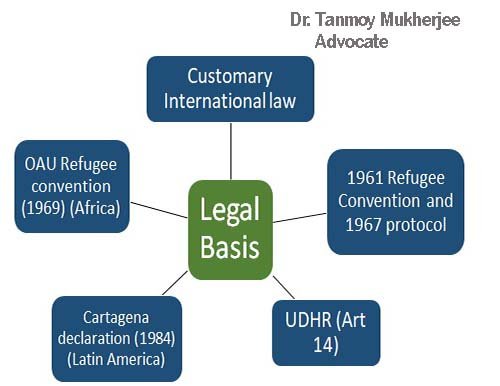
-The right to seek and enjoy asylum [Art. 14(1), UDHR 1948]; and
- obligation of non-refoulement, which prevents states from returning individuals to danger.
Legal sources of Asylum Law-
Treaty Law-
1.The 1951 Convention relating to the status of Refugees-
Article 1 A (2)-
Defines a refugee as a person with a well-founded fear of persecution based on race, religion, nationality, membership of a particular social group, or political opinion.
Article 33(1)-
Establishes the principle of non-refoulement.
Article 31-
Prohibits penalization for illegal entry by refugees coming directly from persecution.
The convention is status-based for asylum protection depends on recognition of refugee status.
2.The 1967 Protocol relating to the status of Refugees-
Removes the 1961 convention's geographical and temporal limitations, making it universally applicable.
3.Regional instruments-
i)OAU convention (1969)-
Expands the definition to include those fleeing external aggression, occupation or events seriously disturbing public order.
Reference Cases-
-African Commission, Modise us. Botswana (2000) -
→Affirmed OAU refugee principles and non-refoulement obligations.
ii)Cartagena declaration (1984)-
Latin American instrument extending protection. Non-binding Latin American instrument extending protecting to those fleeing generalized violence.
4. Human Rights Treaties-
-UDHR 1948 (Art 14) - Right to seek and enjoy asylum.
-ICCPR (Art 7) - prohibits torture and cruel treatment - basis for non refoulement.
-CAT (Art 3) - expressly prohibits returning a person to a state where they face torture.
Reference Cases-
-Agiza vs. Sweden (2005) –
→ Sweden violated Art 3 by expelling an Egyptian facing torture.
ECHR (Art 3) –
Prohibits inhuman and degrading treatment.
Types of Asylum-
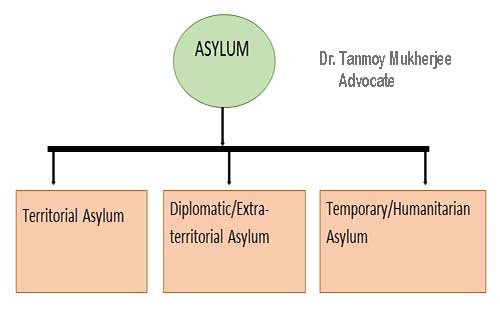
1. Territorial Asylum-
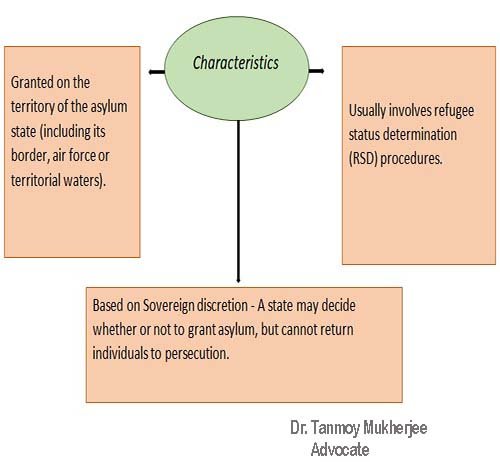
Territorial asylum is the protection granted by a state within its own territory to a foreign national, who seeks refuge there from persecution or danger in their country of origin.
Legal Basis-
Characteristics-
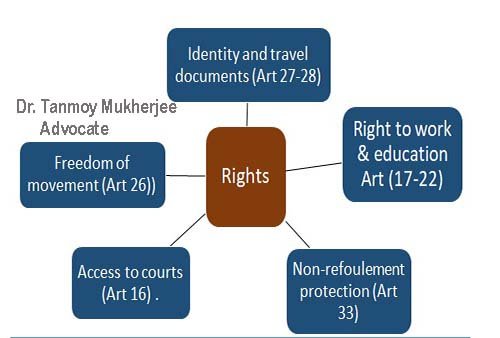
Rights of Persons granted territorial asylum-
Reference Case-
Chahal Vs United Kingdom (1996), ECTHR-
→Deportation of a Sikh separatist would violate Art. 3, ECHR Absolute protection against refoulement.
MSS. Vs Belgium and Greece (2011), ECTHR-
→Returning asylum seekers to Greece under the Dublin regulation violated non-refoulement.
Modise Vs Botswana (African Commission, 2000)-
→ Reaffirmed right to seek asylum and prohibition on expulsion to persecution.
2. Diplomatic Asylum-
Diplomatic asylum is the protection granted by a state outside its territory, typically within-
-Its diplomatic missions (embassies)
-Military ships
-Legations located in the territory of another state.
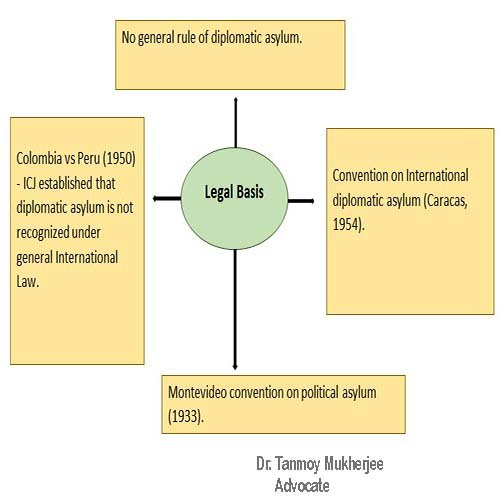
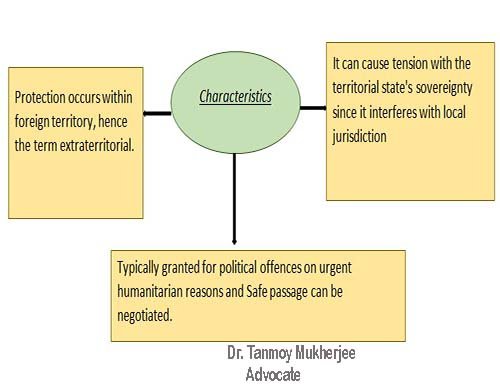
This form of asylum is exceptional and recognized primarily in Latin American practice, not globally.
Legal Basis-
Characteristics-
Reference Case-
Colombia vs Peru (1950)-
→Colombia granted asylum in its Lima Embassy to Peruvian opposition leader, Haya De La Torre.
→Peru demanded his surrender.
ICJ held-
-There is no general right of diplomatic asylum in international law
-It is only valid if based on a regional custom (Latin America)
-Colombia's unilateral qualification of asylum as political was not binding on Peru
3. Temporary Asylum-
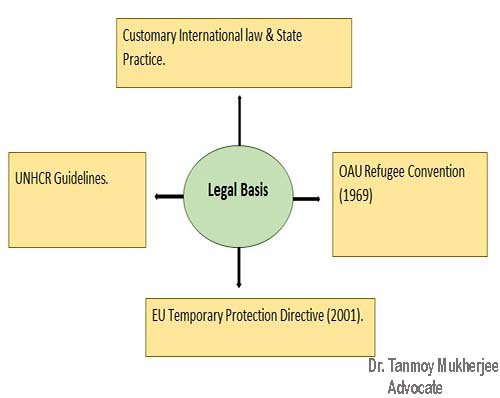
Temporary asylum is protection granted by a State on humanitarian grounds, often in cases of-
-Mass influx (war, civil conflict)
-Environmental disaster
-Generalized violence
Legal Basis-
Characteristics-
i) Granted for limited duration, until safe return is possible.
ii) Based on humanitarian necessity, not legal entitlement.
iii) Basic Rights.
iv) Protection from refoulement.
v) Right to residence.
vi) Right to work.
Reference Case-
Teitiota v. New Zealand (HRC, 2020)-
→The UN human rights committee recognized that climate-induced non-displacement may trigger non- refoulement obligations under ICCPR (Art. 6 & 7).
→ Open door to humanitarian asylum for environmental reasons.
The types of asylum reflects the balance between States sovereignty and international humanitarian obligations.

we believe in a holistic approach to legal education building not just lawyers, but socially conscious leaders of tomorrow.