Artificial Intelligence
TANMOY MUKHERJI INSTITUTE OF JURIDICAL SCIENCE
Dr. Tanmoy Mukherji
Advocate
Artificial Intelligence –
Tanmoy Mukherji
Advocate
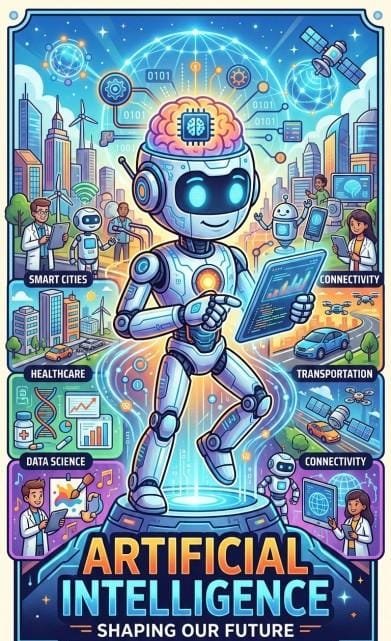
Artificial Intelligence (AI) refers to the ability of machines to perform tasks that normally require human intelligence. These tasks include learning, reasoning, problem-solving, decision-making, and language understanding. AI systems are designed to analyse data, recognize patterns, and improve their performance over time through experience.
→In today’s world, AI plays a vital role in daily life. Virtual assistants like Siri and Alexa, recommendation systems on platforms such as Netflix and Amazon, and navigation apps like Google Maps are all examples of AI. In healthcare, AI helps doctors diagnose diseases more accurately. In education, it supports personalized learning. Industries use AI to increase efficiency, reduce errors, and save time.
→However, AI also raises concerns. Issues like job displacement, data privacy, and ethical decision-making need careful attention. Machines lack emotions and moral judgment, so human supervision is essential.
→Artificial Intelligence is a powerful tool that can greatly benefit society if used responsibly. Proper regulation and ethical use can ensure that AI serves humanity positively.
Role of Artificial Intelligence in Modern Society-
→Artificial Intelligence has become one of the most transformative technologies of the modern era. It has significantly changed the way people live, work, and communicate. AI enables machines to mimic human intelligence and perform complex tasks with speed and accuracy.
→In healthcare, AI assists in early disease detection, robotic surgeries, and drug discovery. In education, AI-based systems offer personalized learning experiences, helping students learn at their own pace. The banking and finance sector uses AI for fraud detection, risk assessment, and customer service through chatbots. In transportation, self-driving cars and intelligent traffic systems are emerging due to AI advancements.
→AI has also improved productivity in industries by automating repetitive tasks. This allows humans to focus on creative and strategic work. However, automation has raised concerns about unemployment, especially for low-skilled workers. Another major concern is data privacy, as AI systems require large amounts of personal data.
→Ethical challenges such as bias in algorithms and lack of accountability in decision-making must be addressed. Governments and organizations should develop strong legal frameworks to regulate AI usage.
→Artificial Intelligence has immense potential to improve society. Balanced development, ethical practices, and human control are essential to ensure AI becomes a boon rather than a threat.
Advantages and Disadvantages of Artificial Intelligence
Artificial Intelligence has both positive and negative aspects, making it a topic of global discussion.
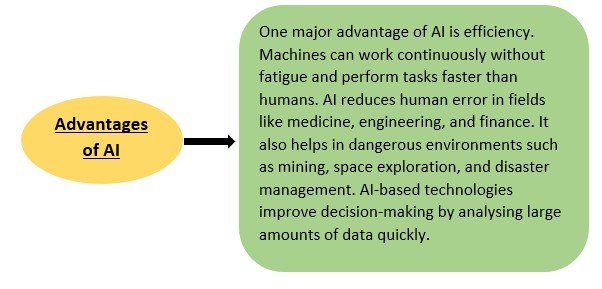
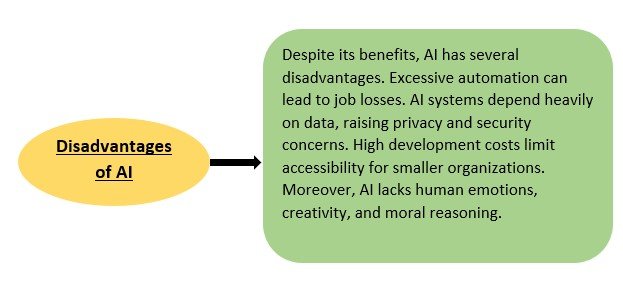
→AI is a double-edged sword. Its advantages can outweigh its disadvantages if used responsibly and ethically.
Artificial Intelligence and the Future of Humanity-
→Artificial Intelligence is shaping the future of humanity in unprecedented ways. As technology evolves, AI is expected to influence almost every sector, including healthcare, education, governance, and defense.
→Future AI systems may outperform humans in many intellectual tasks. Smart cities powered by AI could optimize energy use, transportation, and public safety. In medicine, AI could predict diseases before symptoms appear, leading to longer and healthier lives.
→However, the rapid growth of AI also poses serious challenges. Ethical concerns regarding surveillance, loss of privacy, and misuse of AI in warfare cannot be ignored. The possibility of machines replacing human jobs has created fear and uncertainty.
→To ensure a positive future, AI development must focus on human welfare. Education systems should prepare people with skills that complement AI. Governments must establish strong ethical guidelines and laws.
In conclusion, AI has the potential to either uplift or endanger humanity. The responsibility lies with humans to guide its development wisely.

we believe in a holistic approach to legal education building not just lawyers, but socially conscious leaders of tomorrow.
